
Disclaimer: This post is for educational purposes only. It does not contain affiliate links. All information is based on personal experience and research. I have no financial relationship with any platform or service mentioned in this article.
I almost quit Fiverr before I ever made a single rupee from it.
Not because the platform doesn’t work, it clearly does, for a lot of people. But because nobody gave me a realistic, step-by-step picture of what “making money on Fiverr” actually looks like for someone starting from scratch with no portfolio, no reviews, and no existing reputation online.
What I got instead were YouTube videos of people showing Fiverr dashboards with thousands of dollars in earnings, talking about it like they stumbled into it accidentally. That content made me feel like I was missing something obvious, like everyone else had figured out a secret I hadn’t been told.
The secret, it turns out, is that there’s no secret. It’s a process. A specific, learnable, repeatable process that works when you follow it properly and fails when you skip the parts that feel tedious.
This is that process, written out plainly, from someone who went through the confusing part, so you don’t have to spend as long there.
What Fiverr actually is, and how money gets made there
Fiverr is a marketplace where people who need something done (buyers) find people who can do it (sellers). A buyer posts a need or searches for a service, finds a seller whose gig matches what they’re looking for, places an order, and pays. The seller delivers the work. Fiverr takes 20% of the transaction. The seller keeps 80%.
That 20% cut sounds steep, but what Fiverr provides in exchange is access to millions of buyers worldwide who are already on the platform and already looking to spend money. You don’t have to find clients yourself, build a website, or run ads. The buyers are there. Your job is to make sure they find you and choose you.
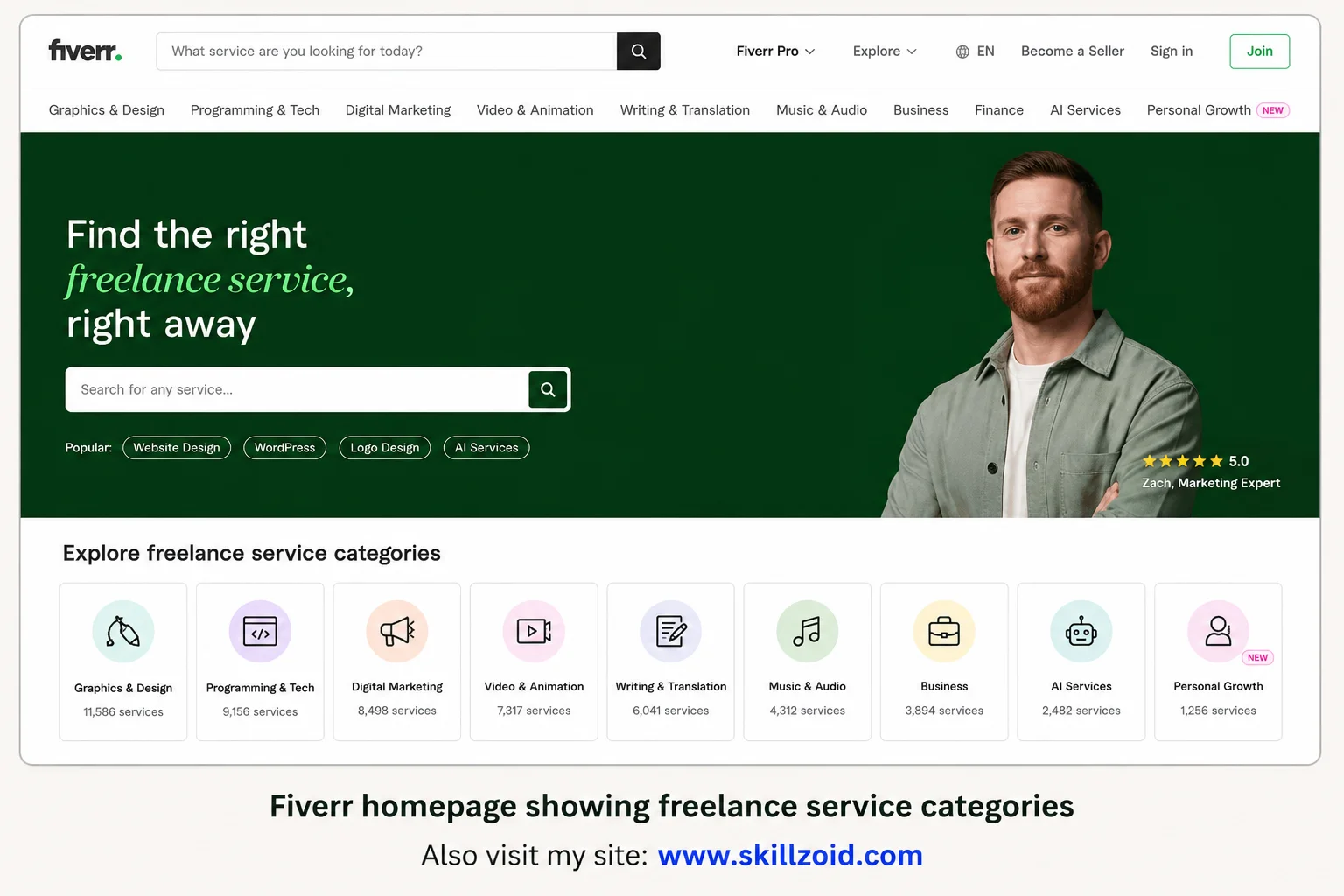
The money gets made by completing orders consistently, building a positive review history, and gradually growing your profile to the point where the platform’s algorithm starts sending you organic traffic.
Simple concept. The complexity is in the execution.
Step 1: Decide what you’re going to sell
This is the decision that determines everything that follows. Get it right, and the rest becomes manageable. Get it wrong, and no amount of effort on the other steps will compensate.
The most important thing to understand: you don’t need to be the best in the world at something to sell it on Fiverr. You need to be genuinely competent, reliable, and able to deliver what you promise. That’s a much lower bar than most beginners assume.
Ask yourself honestly: what can you do that someone else might pay for?
If you’re a strong writer, there’s demand for blog posts, product descriptions, email copy, and proofreading. If you’re comfortable with basic computer tasks, data entry, file formatting, and web research are consistently in demand.
If you’ve spent time learning Canva, logo design, and social media graphics are accessible starting points. If you speak English clearly, voiceover work is an option. If you know WordPress even at an intermediate level, site fixes and setup are well-paid services.
The full list of what works is long. What matters is finding the overlap between what you can genuinely do well and what buyers on Fiverr are actively searching for.
One practical way to research this: go to Fiverr right now, type a skill you have into the search bar, and look at the autocomplete suggestions. Those suggestions come from real buyer searches. If people are searching for it, there’s a market for it.
Step 2: Create your Fiverr account properly
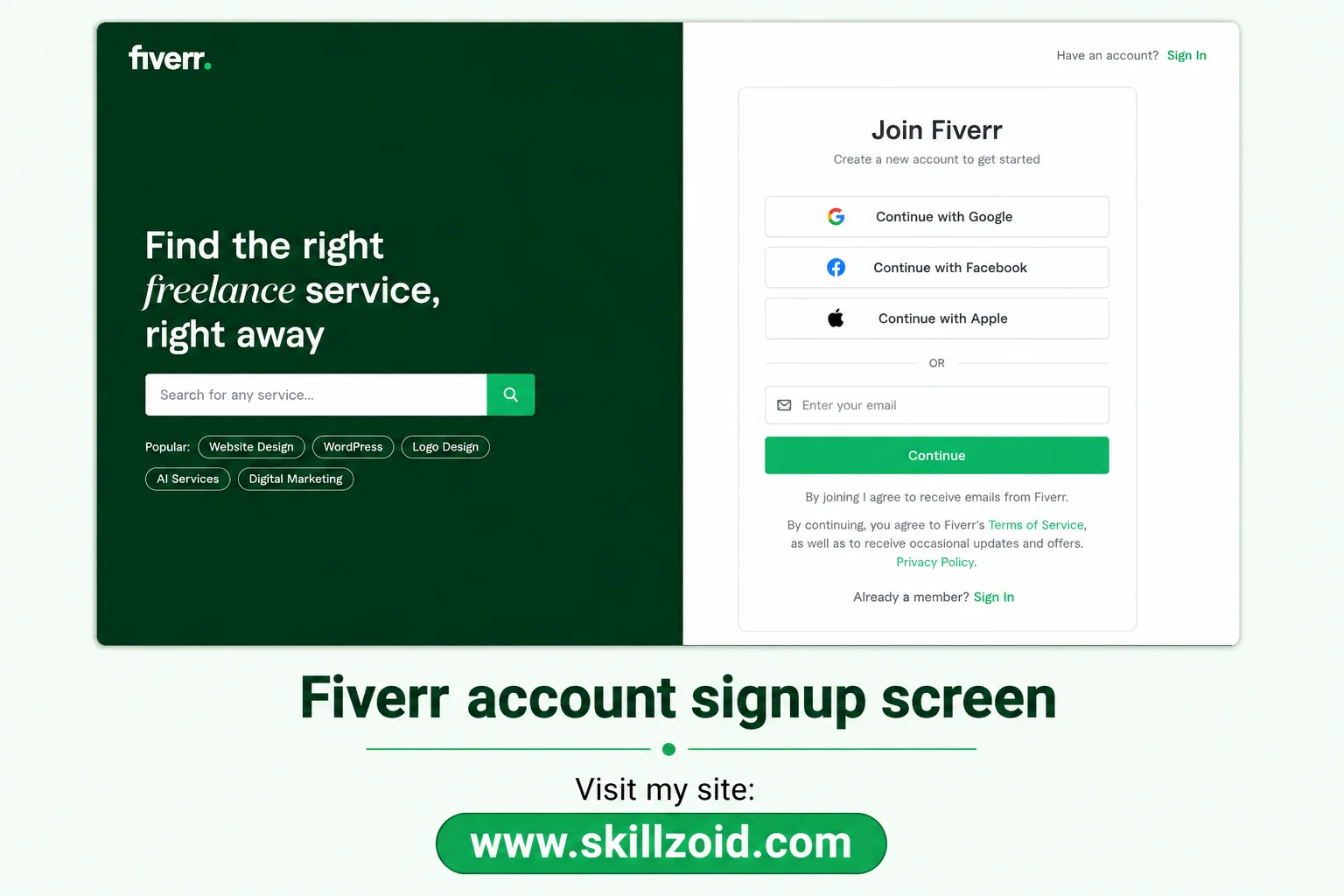
If you haven’t created your account yet, do it properly from the start. A rushed account setup costs you credibility before you’ve even published your first gig.
The key things to get right during account creation:
Username: Choose carefully because it cannot be changed. Keep it clean, professional, and ideally related to the work you’ll be doing. It becomes part of your permanent profile URL.
Profile photo: Use a real, clear headshot of your face. Not an avatar, not a logo, your actual face, in decent light. Buyers trust people more than icons, and this is one of the simplest trust signals you can control.
Profile description: Write two to three short paragraphs in your own voice. Be specific about what you offer and what kind of work you enjoy. Avoid the generic “passionate professional” language that everyone uses, and nobody believes.
Skills section: Fill it in accurately with the skills relevant to your service. These help Fiverr’s system categorize your profile beyond just your gig keywords.
Phone verification: Complete this before you try to publish a gig, because you’ll hit a wall if you don’t.
Payment method: Set up Payoneer (for Pakistani sellers, this is the most practical option) and complete the verification process. It can take a few days, so start it early.
Step 3: Create your first gig
Your gig is your product listing, the page buyers land on when they find you in search or click your profile. Every element of it matters, and the choices you make here determine whether visitors convert into buyers.
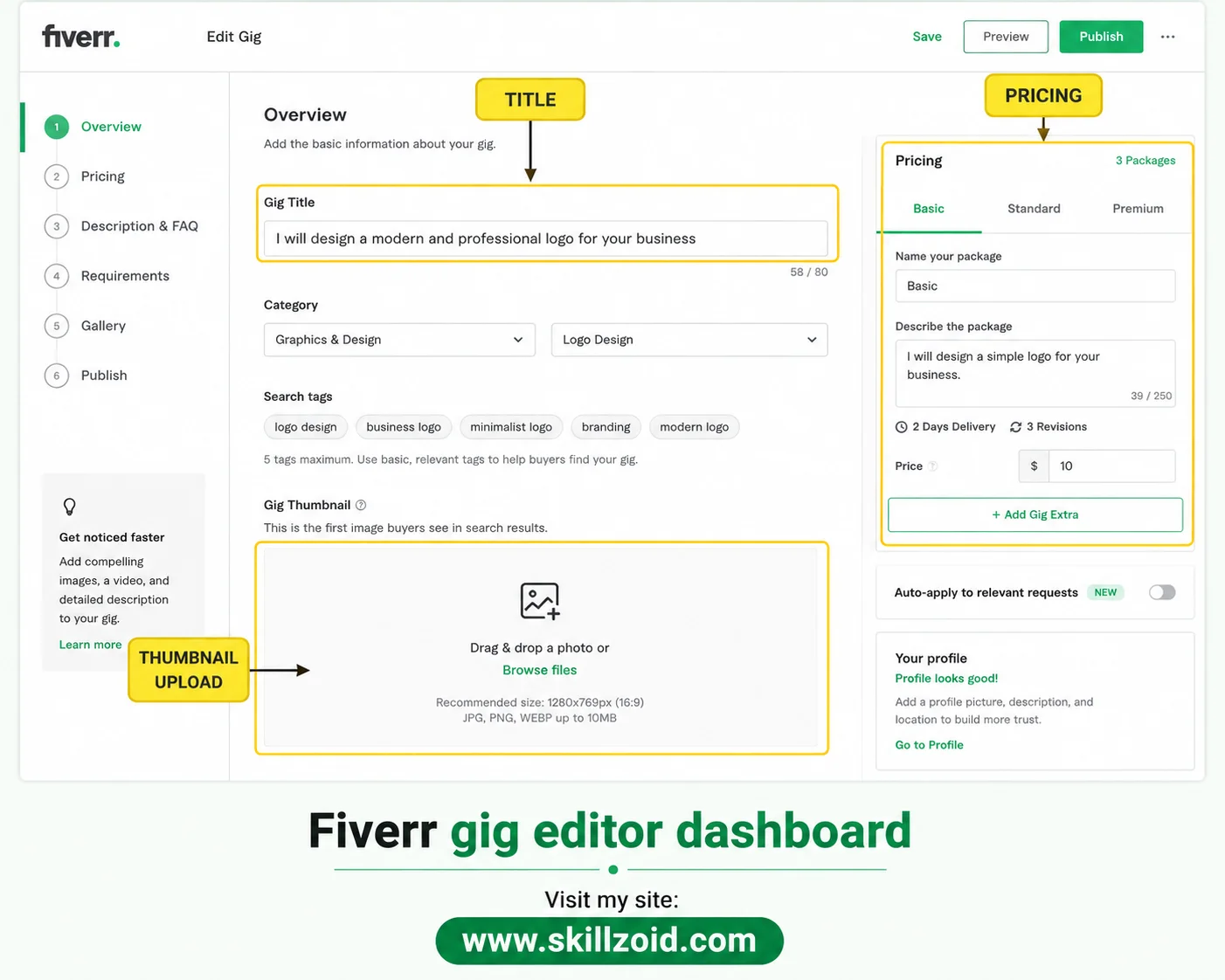
Gig title
Write a title that matches how buyers actually search, not how you’d describe your service from your own perspective. Go back to that Fiverr search autocomplete and use those real buyer search terms as your guide.
“I will do data entry from PDF to Excel spreadsheet” is better than “I will provide data entry services.” The first one is specific and matches a real search query. The second is generic and ranks for nothing.
Category and subcategory
Choose the most accurate match for your service. Fiverr’s category selection affects where your gig appears in browse results. Don’t try to fit into an adjacent category because it seems less competitive; accuracy matters more.
Gig description
Open with the buyer’s problem, not your credentials. They came to Fiverr because they have something that needs to be done, speak to that first.
Then explain clearly what they’ll receive, how you work, and what makes your process reliable. Keep paragraphs short. Use bullet points for package inclusions. Make it easy to skim because most buyers do not read every word.
Include your primary keyword naturally in the first 150 characters of the description. Fiverr’s internal search algorithm weights this section heavily for indexing.
Gig packages
Fiverr lets you offer Basic, Standard, and Premium tiers. Even if you start with a simple single package, setting up three tiers eventually gives buyers more choice and increases your average order value when buyers upgrade.
For your Basic package, be very clear and specific about what’s included. Vague package descriptions lead to scope disputes, which lead to cancellations, which hurt your metrics.
Gig FAQ
Most sellers leave this empty. Don’t. Add four to five genuine frequently asked questions, what information do you need to start, how many revisions are included, what format will the deliverable be in, and what happens if the buyer isn’t satisfied. Answering questions reduces buyer hesitation and makes your gig page more complete.
Gig thumbnail
Your thumbnail is the visual that appears in search results. Buyers see it before they read a single word. A clean, high-contrast thumbnail with readable text at small sizes outperforms a busy, complicated one every time.

Open Canva, look at what the top performers in your category are doing visually, and build something clean and specific. Test your thumbnail by shrinking it to roughly 200 pixels wide on your screen. If the text is illegible at that size, redesign it.
Step 4: Get your first order, don’t wait for it to come to you
This is the step most beginners handle wrong, and it’s why so many people publish a gig and then sit in silence for weeks, wondering why nothing is happening.
Fiverr’s algorithm does not give new gigs meaningful visibility by default. It needs evidence that your gig converts, that real buyers click on it and place orders, before it starts promoting you in search results. But you can’t get conversions without visibility, and you can’t get visibility without conversions.
The way out of this loop is to generate your own first traction manually.
Tell your personal network you’ve started freelancing on Fiverr. Be specific about what you offer. Ask friends, family, or classmates who have genuine tasks to hire you through the platform properly, not for a fake review, but because they actually need the work done. A real order from someone you know, completed well, with an honest review at the end, is identical in algorithmic value to an order from a stranger.
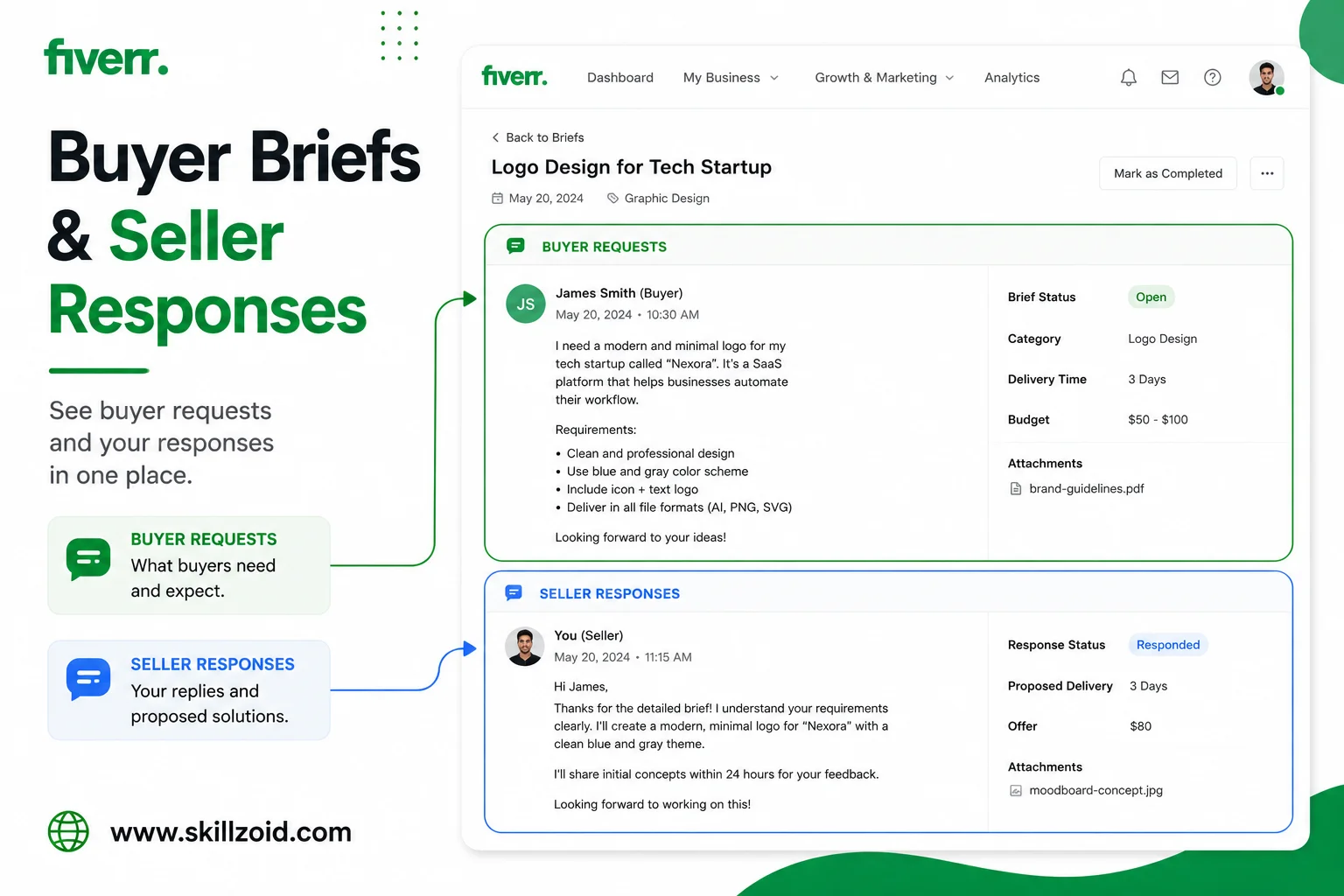
Also, use Fiverr’s Briefs feature actively. This is where buyers post what they’re looking for, and sellers respond with offers. Write personalized, specific responses that show you actually read their brief, not copy-paste templates that every other seller is sending.
Share your gig link on your WhatsApp status, in relevant Facebook groups where your audience hangs out, and on any other platform where you have even a small following. Be specific about what you offer rather than just dropping a link with no context.
Step 5: Deliver your first orders with more care than you think is necessary
Your first five reviews are disproportionately important. They define your profile’s reputation and your algorithm standing for months after they’re posted.
Over-deliver on every early order. Not in a way that’s unsustainable, but in a way that genuinely surprises the buyer with a positive, unexpected detail. An extra variation they didn’t request. A faster delivery than promised. A brief note explaining something about the work they might find useful.
These small additions cost you an extra ten to fifteen minutes. But they’re the things buyers mention specifically in reviews, and detailed, enthusiastic reviews carry more algorithmic weight than a five-star click with no comment.
After delivery, send a natural follow-up: something like “Really glad to complete this for you, if you’re happy with how it turned out, a quick review would genuinely help my profile as a new seller.” Most satisfied buyers will leave a review when asked directly. Most don’t leave one when not asked, not because they’re unhappy, but because they’ve already moved on.
Step 6: Stay active and maintain your metrics
Fiverr tracks several metrics that affect your visibility and your seller level: response rate, response time, order completion rate, on-time delivery rate, and overall rating.
In the early weeks, especially, treat these like your most important KPIs.
Respond to every message within an hour when you’re active. Use Fiverr’s app notifications so you don’t miss incoming messages. Set a delivery timeline for your gig that you can hit comfortably even on a busy day, and then deliver before that deadline when possible.
If you’re going to be unavailable for more than a day or two, turn on Fiverr’s Out of Office mode. This pauses your gig visibility temporarily but protects your response rate, which is the smarter trade-off.
Step 7: Raise your prices as your reviews grow
This step gets skipped constantly, and it’s one of the main reasons sellers burn out.
If you’re charging $10 for work that takes you two hours, you’re earning $4 after Fiverr’s cut, $2 an hour. That’s not a business. It’s exhausting yourself at below-minimum wage rates.
Every time you hit a meaningful milestone, ten reviews, twenty-five reviews, Level 1 status, Level 2 status, revisit your pricing and raise it deliberately. Some buyers at the old price won’t follow you to the new one. That’s fine. The buyers who stay are paying you what your work is actually worth.
The goal on Fiverr is not to have the most orders. It’s to earn a meaningful income while doing work you can deliver well. Those are different targets, and pricing is how you align them.
The mistakes that slow most beginners down
Starting with a vague, oversaturated gig. “I will write content for you” competes with hundreds of thousands of sellers. “I will write SEO blog posts for food and lifestyle brands” competes with a fraction of that number and speaks directly to a specific buyer. Specific gigs outperform generic ones in both ranking and conversion.
Editing the gig constantly in the first few weeks. Every significant edit resets Fiverr’s evaluation period for that gig. Sellers who tweak their title, description, and thumbnail every few days are effectively restarting from zero repeatedly. Publish your best effort, then leave the gig alone for at least two to three weeks before making any major changes.
Setting delivery times that sound impressive but aren’t realistic. A 24-hour delivery looks great until a real order comes in on a day you’re busy, and you deliver late. A late delivery in your first few orders damages your on-time delivery rate and takes weeks to recover from. Set timelines you can hit reliably.
Ignoring the buyer’s requirements. Some buyers provide detailed requirements in their order form. Reading them carefully before starting, and asking one or two clarifying questions when something is unclear, reduces revisions, prevents disputes, and leaves buyers feeling heard. Most sellers skim this step. Don’t.
Quitting after a slow first month. The first month on Fiverr is almost always the hardest and the quietest. Fiverr’s algorithm doesn’t know you yet. Your profile has no history. You’re invisible to most buyers. This is normal. The sellers who push through the first month, who actively pursue their first few orders instead of waiting for them, are the ones who find that months two and three look meaningfully different.
What to realistically expect
Month one is mostly groundwork. A few clicks, possibly one or two orders if you’re actively pursuing them, and the beginning of a profile that has at least some evidence of activity.
In months two and three, with a handful of genuine reviews, you start to see organic traction. Buyers begin finding your gig through search without you actively driving them there.
Months four through six, with consistent delivery and strong reviews, a reliable order flow becomes realistic. What “reliable” means in dollar terms depends heavily on your niche, pricing, and how much you’ve invested in optimizing your gig, but $300 to $800 a month is achievable for someone consistent.
Beyond that, the ceiling rises with your skill, your specialization, and how seriously you treat Fiverr as an actual business rather than a passive income tap you turned on and forgot about.
One thing I’d tell my earlier self
Stop waiting for permission from the algorithm.
The algorithm rewards performance, but you have to create the initial performance yourself. The sellers who move fastest on Fiverr are not the ones with the most impressive skills; they’re the ones who take action first, learn from each order, and keep showing up consistently even when the early results are modest.
Your first order is the hardest one. Your second is easier. By your tenth, you’ll barely remember why it felt so daunting to start.
Go start.
Taha Sohail is a cyber engineer and blogger who writes about freelancing, Fiverr, affiliate marketing, and online income at Skillzoid.com. His content focuses on beginner-friendly, realistic strategies for building digital income streams.
Related reading: How to Create a Fiverr Account Step by Step (2026 Guide) | How to Get Your First Order on Fiverr Fast (2026 Guide) | How to Build a Full-Time Income on Fiverr in 2026




2 Comments on “How to make money on Fiverr (beginner) (Step-by-Step Guide)”