
Let me be straight with you from the start: Fiverr is not a passive income platform in the traditional sense.
There is no version of this where you set up a gig, go to sleep, and wake up to money in your account without doing any work. Anyone telling you that is selling you a fantasy, and usually trying to sell you a course along with it.
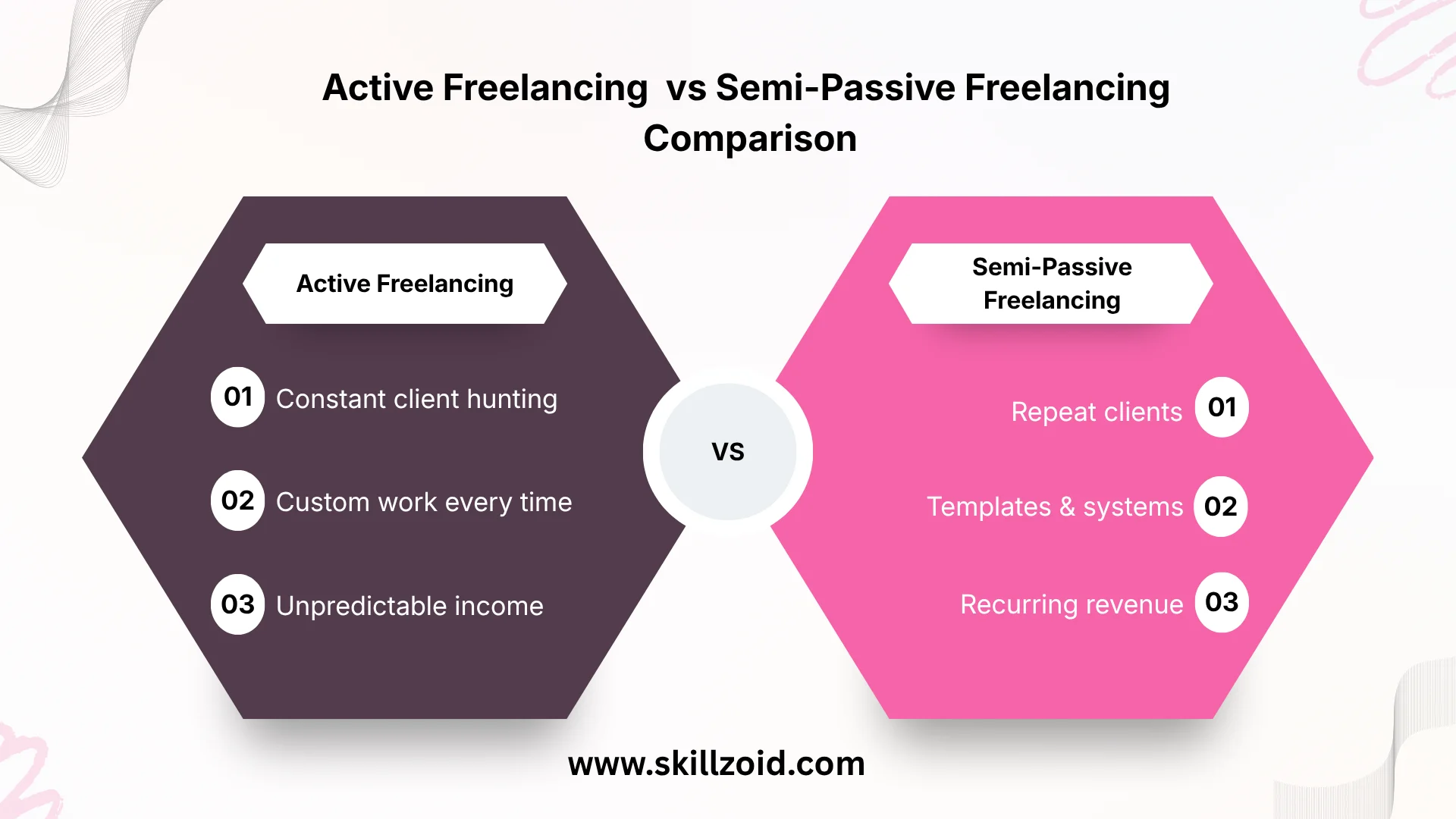
What Fiverr can become, with the right setup, is something close to semi-passive income. Meaning: income that requires significantly less of your active time per rupee or dollar earned than it did when you started. Recurring clients who order without you chasing them. Productised gigs that you can deliver in a fraction of the time it once took. Systems that mean you are not starting from scratch with every single order.
I have been there. Early in my Fiverr career, every order felt like a full production, new brief, new research, new back-and-forth with the client, new delivery, new revision round. It was active income in the most exhausting sense. Over time, I built structures that made the same type of work take half the time and generate repeat revenue without constant marketing.
That is what this article is actually about. Not a shortcut. A smarter system.
The Honest Definition of “Passive” on Fiverr
Before building anything, you need a realistic mental model of what you are aiming for.
True passive income, dividend payments, rental income, royalties, earn money while you do nothing. Fiverr is not that. Every order needs to be fulfilled. Every client needs communication. The platform requires you to stay active, or it will deprioritise your gigs in search results.
What is achievable on Fiverr is a scalable, lower-effort income, where the income grows faster than the time you invest. That gap between time invested and money earned is what people actually mean when they say “Fiverr passive income,” even if they do not frame it that way.
The strategies below are designed to widen that gap. They are legitimate, they work, and they take time to build, but they are genuinely worth building.
Strategy 1: Build Recurring Clients Who Order Without Being Chased
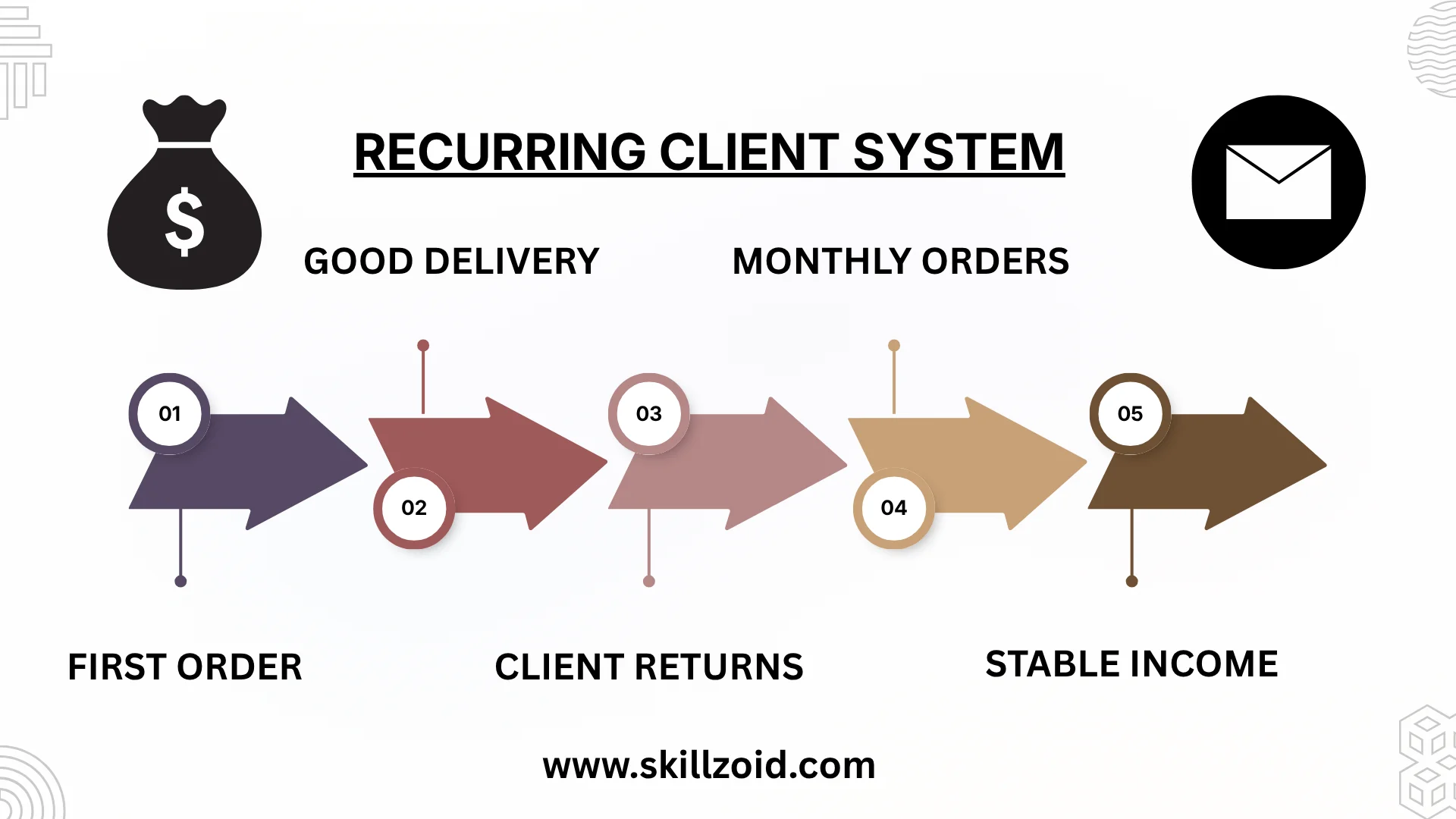
The closest thing to passive income on Fiverr is a repeat client who orders regularly without you having to pitch them every time.
Think about what that looks like in practice. A content marketing agency that needs four blog posts a month. A small business owner who orders a new batch of social media graphics every two weeks. A startup that sends you one editing project every time they publish a new video.
These clients exist. Getting them requires two things: delivering work so reliably good that re-ordering is easier than finding someone new, and structuring your communication so that staying in touch feels natural rather than pushy.
After delivering a project, I always send a short follow-up message. Not a pitch. Something like: “Really glad this worked out, feel free to message me whenever the next one comes around. Happy to keep the same approach so we do not have to start from scratch each time.”
That last phrase is deliberate. It signals continuity, the idea that working together again will be easier than the first time, which is true and valuable to a busy buyer.
Over time, recurring clients become the backbone of a more stable Fiverr income. They require less convincing, less briefing, and less time per order because you already understand their preferences. The work gets faster. The income stays consistent.
Strategy 2: Productise Your Service Into a Repeatable System
The reason most freelancers stay stuck in the time-for-money trap is that they treat every order as a custom project. And some orders genuinely are custom. But many are not; they just feel that way because there is no system behind them.
Productising means turning a repeatable service into a defined, templated process that you can execute consistently with less decision-making each time.
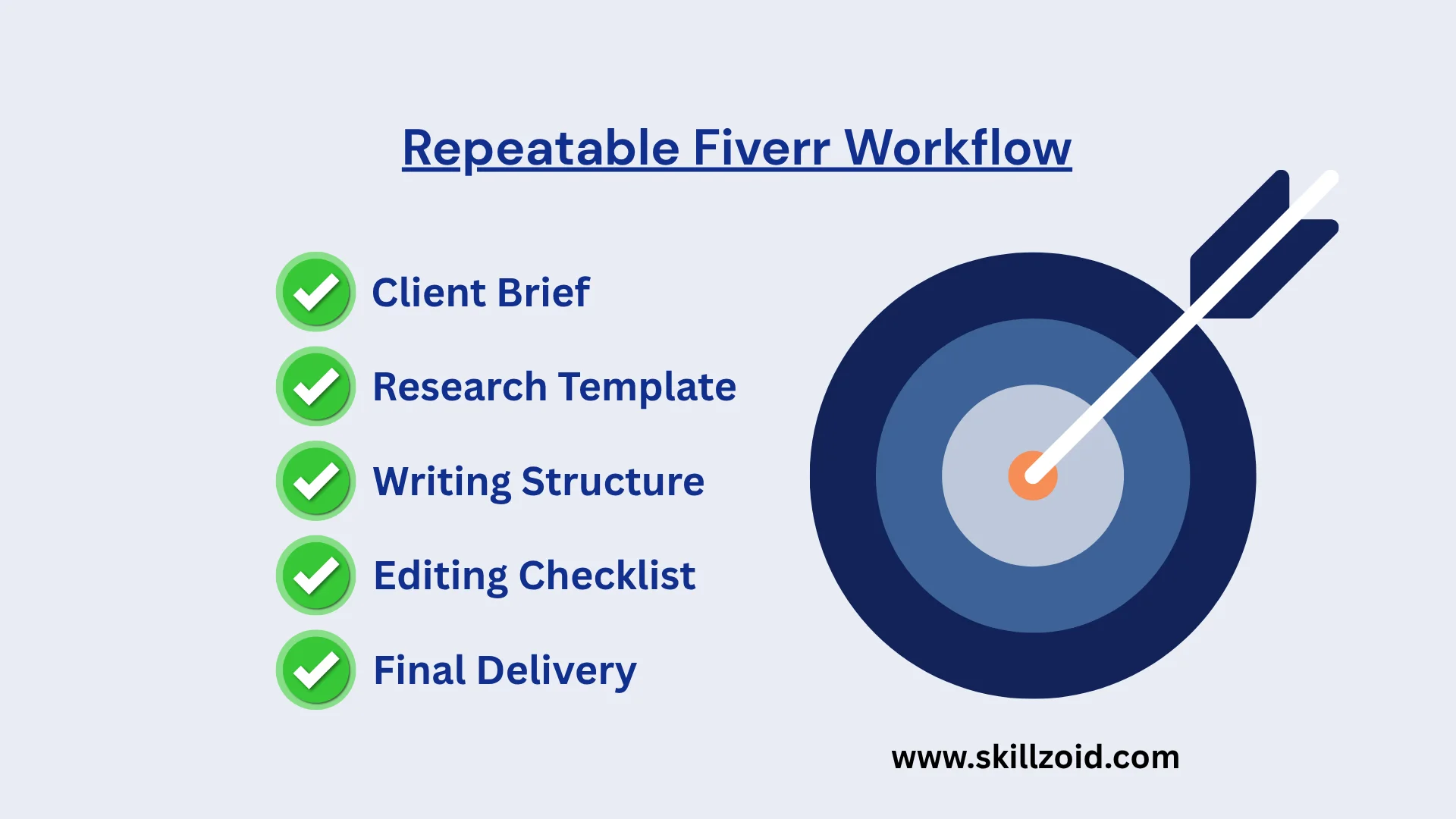
For a content writer, this might mean: a fixed intake questionnaire that captures everything needed to write an article without back-and-forth, a document template that is already formatted and ready to fill, a checklist that ensures quality without re-reading everything from scratch.
For a designer, it might mean: a set of base design files for common project types, a brand questionnaire that collects client preferences upfront, a revision process that operates within a defined scope rather than open-ended feedback loops.
The first time you do any type of project, it takes full effort. The tenth time, if you have built a system, it should take noticeably less. The fiftieth time, you are essentially running a process, not reinventing something from scratch.
I built a writing template for my cybersecurity articles that included a standard structure, a pre-researched set of source links I trusted, and a formatting guide I sent clients upfront. What used to take me three hours started taking ninety minutes. Same quality. Half the time. Twice the effective hourly rate.
That is not passive. But it is meaningfully closer to it.
Strategy 3: Use Fiverr Subscriptions to Lock In Recurring Revenue
Fiverr introduced a subscription feature that allows sellers to offer their services on a recurring weekly or monthly basis. Buyers subscribe to your gig and are automatically billed each period. You deliver on the agreed schedule.
This is the most structurally passive-adjacent feature Fiverr actually offers.
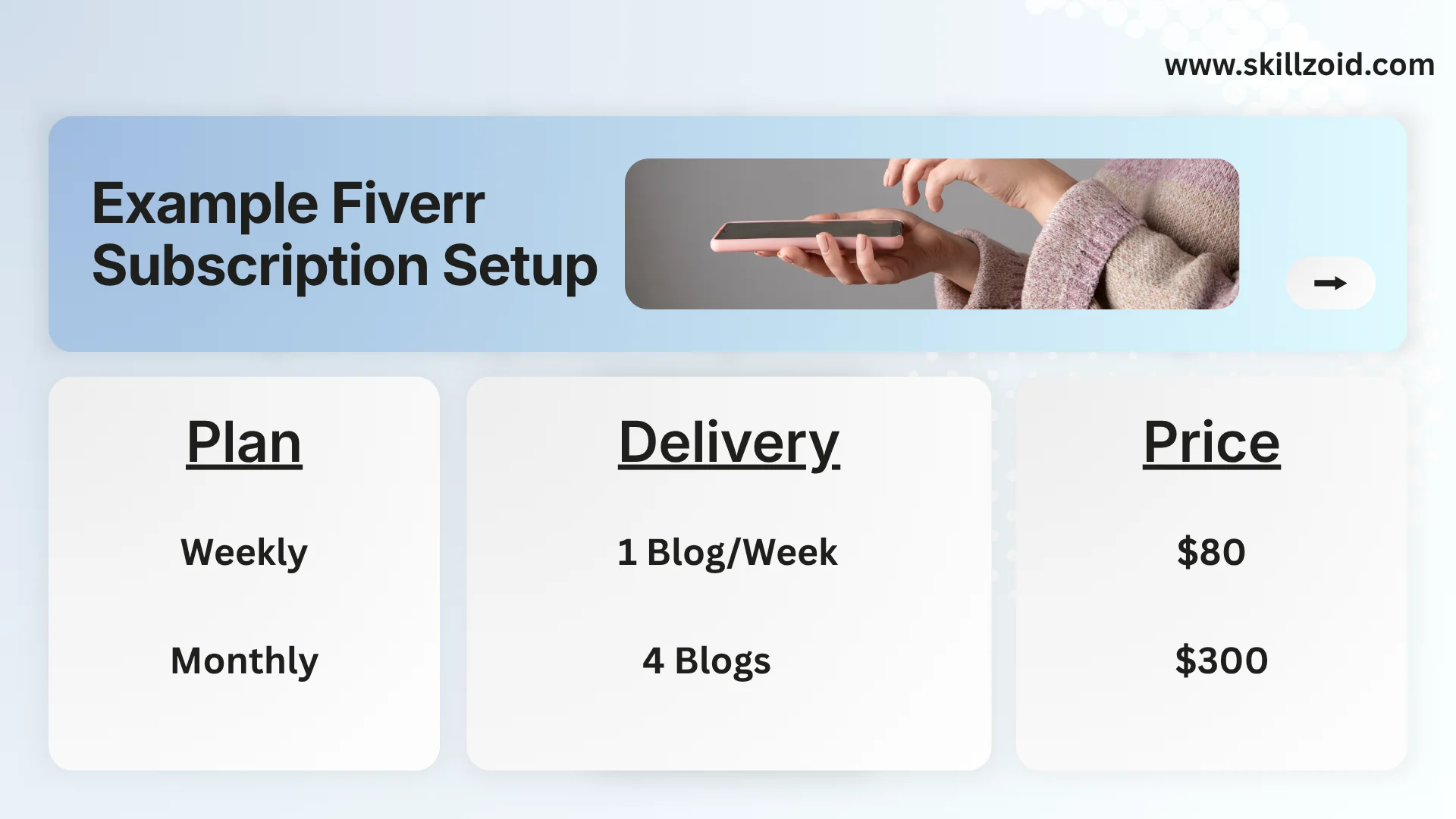
For buyers, it removes the friction of re-ordering every time. For sellers, it provides predictable, recurring income that does not depend on the buyer remembering to come back or you actively marketing yourself each month.
To set this up, go to your gig editing page and look for the subscription option under your package settings. You can enable it for any tier and set the billing cycle to weekly, monthly, or quarterly.
Services that work well as subscriptions: social media content packages, monthly SEO article bundles, ongoing graphic design retainers, regular data reporting, and weekly video editing for content creators.
The key is offering a meaningful incentive for the subscriber versus single-order pricing. A 10 to 15 percent discount for subscribers is usually enough to make the commitment worthwhile for the buyer, while the predictability of recurring revenue makes it worthwhile for you.
Even two or three active subscribers generating consistent monthly income changes the financial texture of your Fiverr operation considerably. It is the difference between hunting for orders every week and waking up with confirmed work already in your queue.
Strategy 4: Offer Digital Products Through Fiverr
This is the strategy that comes closest to genuine passive income, and it is underused by most sellers.
Fiverr allows sellers to create gigs that deliver digital products: templates, guides, preset files, swipe files, spreadsheets, prompt packs, Notion dashboards, Lightroom presets, CapCut templates, and similar items.
The difference between a service gig and a product gig is significant from an income perspective. A service gig requires you to do something new for every order. A product gig requires you to create something once and deliver that same file to every buyer who orders.
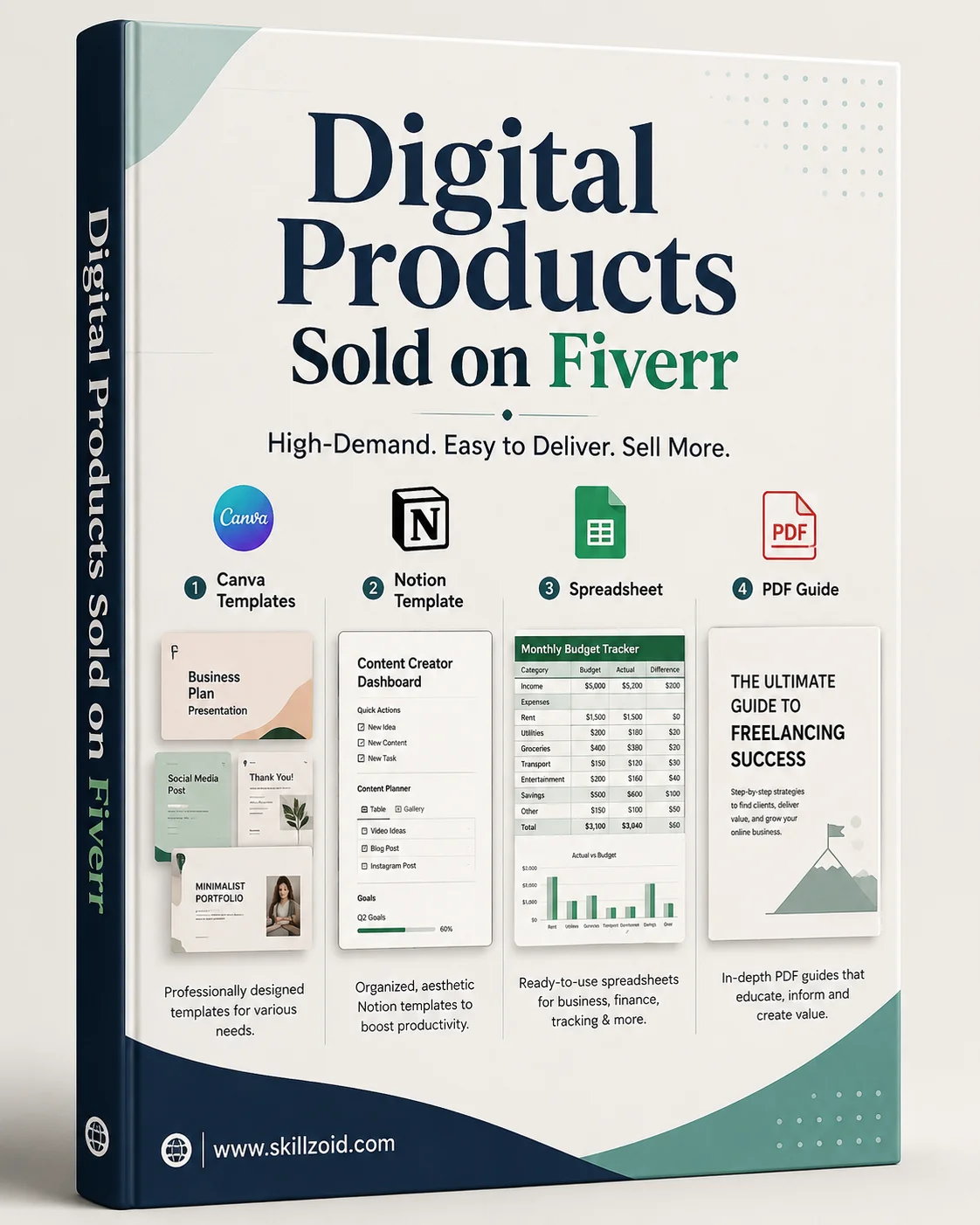
If you are a graphic designer, you could create a set of 20 Instagram story templates in Canva and sell them as a gig. Every order is a file delivery, no custom work, no revision rounds, no briefing process. You deliver the same zip file to every buyer.
If you are a writer, a swipe file of 50 proven email subject lines or a prompt library for a specific industry can be sold repeatedly without additional work per order.
If you work in SEO or digital marketing, a pre-built keyword research spreadsheet or a website audit checklist template can be delivered instantly to every buyer.
The upfront investment is real, and creating a high-quality digital product takes time. But once it exists, each sale requires almost nothing from you beyond the initial delivery. That is as close to passive as Fiverr gets.
One honest caveat: these gigs require strong SEO and good reviews to generate consistent sales, because buyers cannot evaluate what they are getting from the description alone as easily as they can with a service. Your gig image and description need to be exceptionally clear about exactly what is included.
Strategy 5: Create Gig Packages That Scale Your Time
Most sellers price their gig packages by deliverable volume, more words, more designs, more videos for the higher tiers. That is fine, but it ties your income directly to your output.
A smarter approach for building scalable income is to price your premium packages around speed, priority access, and inclusion, not just quantity.
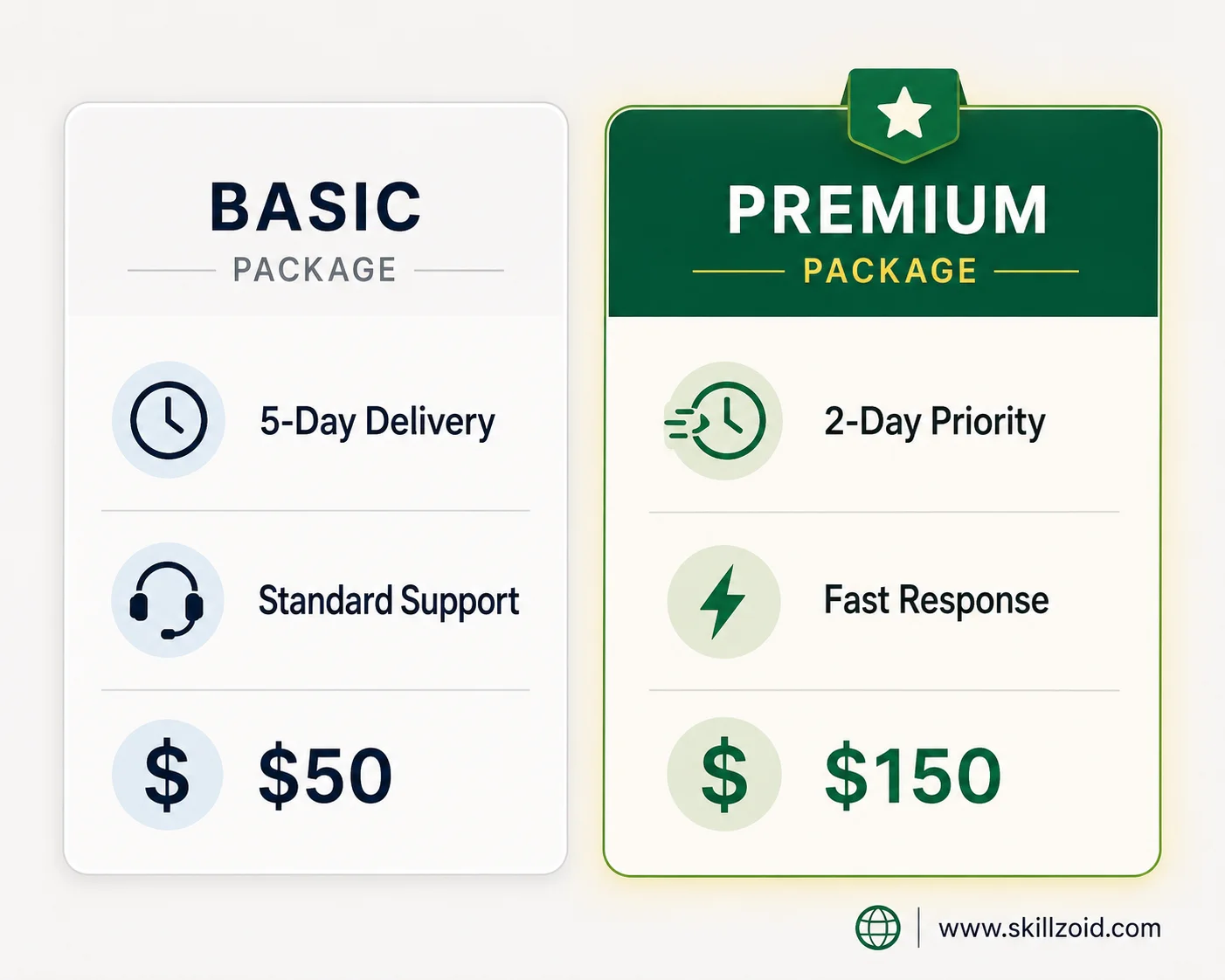
Your Basic package delivers in five days. Your Premium package delivers in two days with a dedicated communication slot and first-priority handling. Your Premium buyer is not necessarily getting more work; they are getting more of your attention, faster. That premium is worth charging for, and it does not proportionally increase your workload.
This restructuring means your highest-earning orders do not automatically become your most time-consuming ones. A Premium buyer paying three times your Basic rate might take thirty percent more of your time, not three hundred percent. That gap is where scalability lives.
What Actually Takes You Closer to Passive, and What Does Not
A few things worth being honest about, from experience:
What moves you toward scalable income: Repeat clients. Productised systems. Subscription gigs. Digital product gigs. Premium packages priced on value rather than volume. Strong reviews that generate organic orders without active promotion.
What does not: Buying fake reviews, using gig exchange schemes, or automating responses with chatbots that pretend to be you. These violate Fiverr’s Terms of Service, and accounts get banned permanently. There is no passive income from a banned account.
Going offline for extended periods in the hope that past optimisation carries you. Fiverr actively reduces the visibility of inactive sellers. The platform rewards consistent presence.
And the biggest one: expecting this to happen quickly. Building recurring clients, establishing subscription income, and creating sellable digital products all take months of consistent effort before they generate meaningful returns. The sellers who build genuinely scalable Fiverr income are the ones who are committed to a long timeline, not the ones who tried it for three weeks.
The Honest Expectation
Six months of focused work on the strategies above can put you in a position where a meaningful portion of your Fiverr income is recurring, predictable, and requires significantly less active effort per order than when you started.
That is not a guarantee. It is a realistic outcome for sellers who build systems, maintain quality, and stay consistent.
It is also not passive in any pure sense. You will still be working. But the ratio of income to effort will look meaningfully different from where you started, and that ratio, compounded over time, is what financial progress on a freelance platform actually looks like.
Build the system. Deliver the quality. Stay patient with the timeline.
The income that feels easy later is built by the work that felt hard first.
Disclaimer
Income results on Fiverr vary significantly based on skill level, niche, competition, and the effort invested. The strategies in this article are based on real experience and honest analysis, not guarantees of specific earnings. Treat all income estimates and projections you encounter online with healthy scepticism.
If you want to learn about how students can earn money on Fiverr, read this guide: Fiverr Freelancing for Students: Earn While Studying (Step‑by‑Step) in 2026.
Taha Sohail is a professional blogger and cyber engineer with hands-on Fiverr selling experience across multiple service categories. He writes practical, no-fluff guides for freelancers building sustainable online income.



2 Comments on “How to Turn Fiverr Gigs into Passive Income Streams in 2026”