
Disclaimer: This post is for educational purposes only. It does not contain affiliate links. All information is based on personal experience and research. I have no financial relationship with any platform or service mentioned in this article.
My younger cousin called me last year with a very specific question.
He had just finished his intermediate exams, had a lot of free time, needed pocket money, and had heard that people make money on Fiverr. His exact words were: “Bro, I know nothing, no designing, no coding, nothing. Can I still earn from Fiverr?”
I told him yes, but I also told him the honest version of yes. Not the YouTube thumbnail version that claims someone makes $500 a week doing nothing. The real version, where it takes some initial effort, some patience, and a clear understanding of which tasks are actually accessible to a complete beginner.
He started three months ago. He’s made just over $200 so far. Not life-changing money, but real money, from a platform he thought required skills he didn’t have.
If you’re in the same position he was, this guide is for you.
First, let’s address the “no skill” part honestly
Here’s the thing: “no skill” is a little misleading as a concept, and I’d be doing you a disservice if I didn’t say that upfront.
Everyone who earns money, on Fiverr or anywhere, provides some form of value in exchange. What’s actually true is that you don’t need specialized or technical skills like coding, graphic design, or video production to start earning on Fiverr.
What you do need are basic abilities most people already have: the ability to read and write clearly, follow instructions carefully, use a computer, and communicate professionally. If you have those, and I’m guessing you do, since you’re reading this, you have enough to start.
The services I’m going to describe don’t require years of training or expensive software. They’re tasks that buyers genuinely need done and are willing to pay for, and they’re accessible enough that a motivated beginner can start delivering them within days.
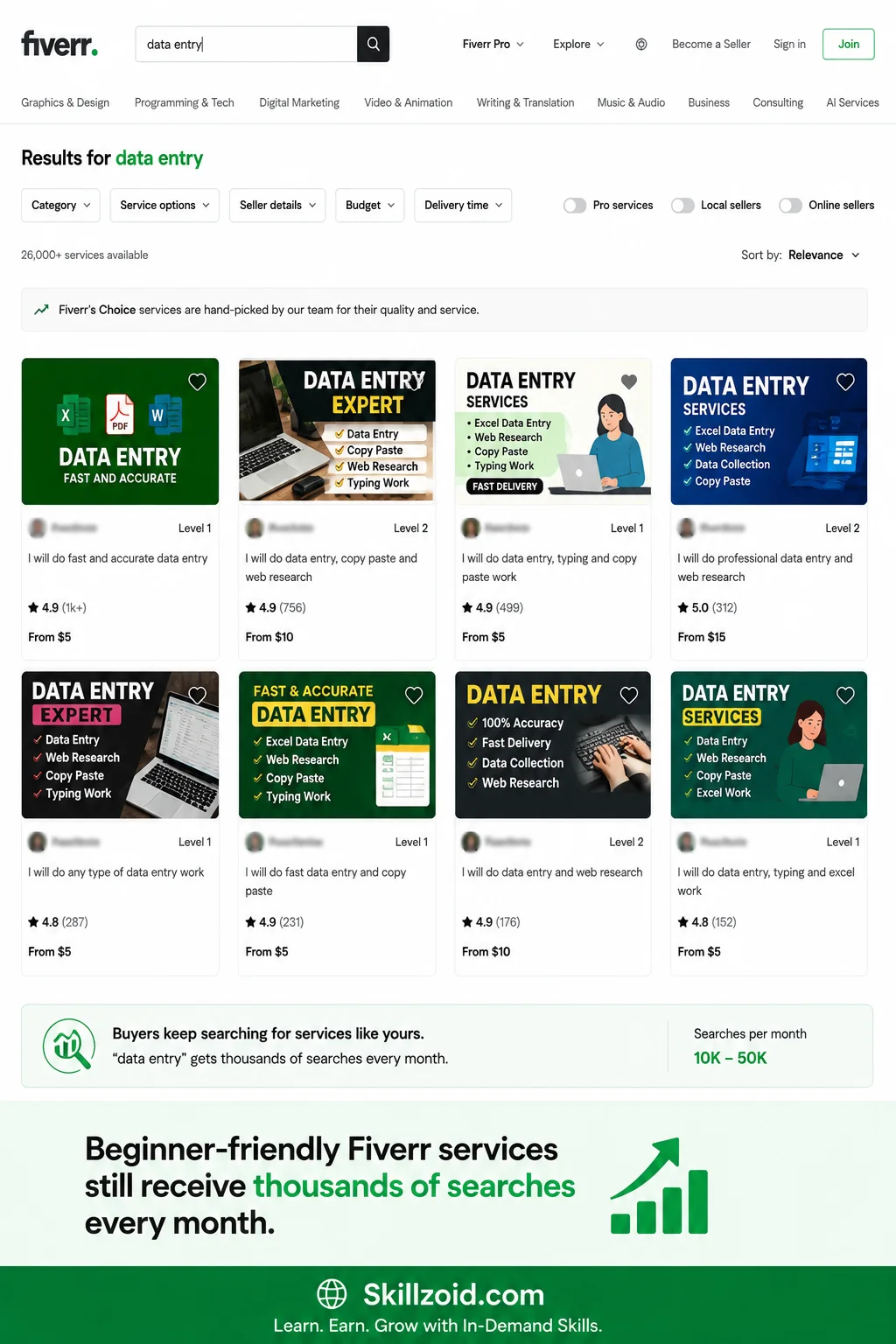
1. Data Entry: The most beginner-accessible service on the platform
If you can type accurately and follow instructions without losing focus, you can offer data entry services on Fiverr right now.
Data entry work covers a wide range of tasks: copying information from one format to another, filling in spreadsheets, transcribing text from images or PDFs into editable documents, organizing contact lists, and updating databases. None of this requires technical knowledge, just attention to detail and reliability.
Buyers who need data entry done are often small business owners, researchers, or professionals who have the data but not the time to organize it themselves. They’re not looking for someone with impressive credentials; they’re looking for someone who will do it accurately and on time.
My cousin started here. His first gig was simple: “I will manually enter data from images or PDFs into Excel or Google Sheets.” Clean title, clear deliverable, priced at $15 for up to 50 rows. His first order came from a small business owner who needed product information entered into a spreadsheet. It took him about 90 minutes. He earned $12 after Fiverr’s cut.
Not glamorous. But it was a real order, a real review, and a real starting point.
Tools you’ll need: Microsoft Excel or Google Sheets (Google Sheets is free). That’s genuinely it to start.
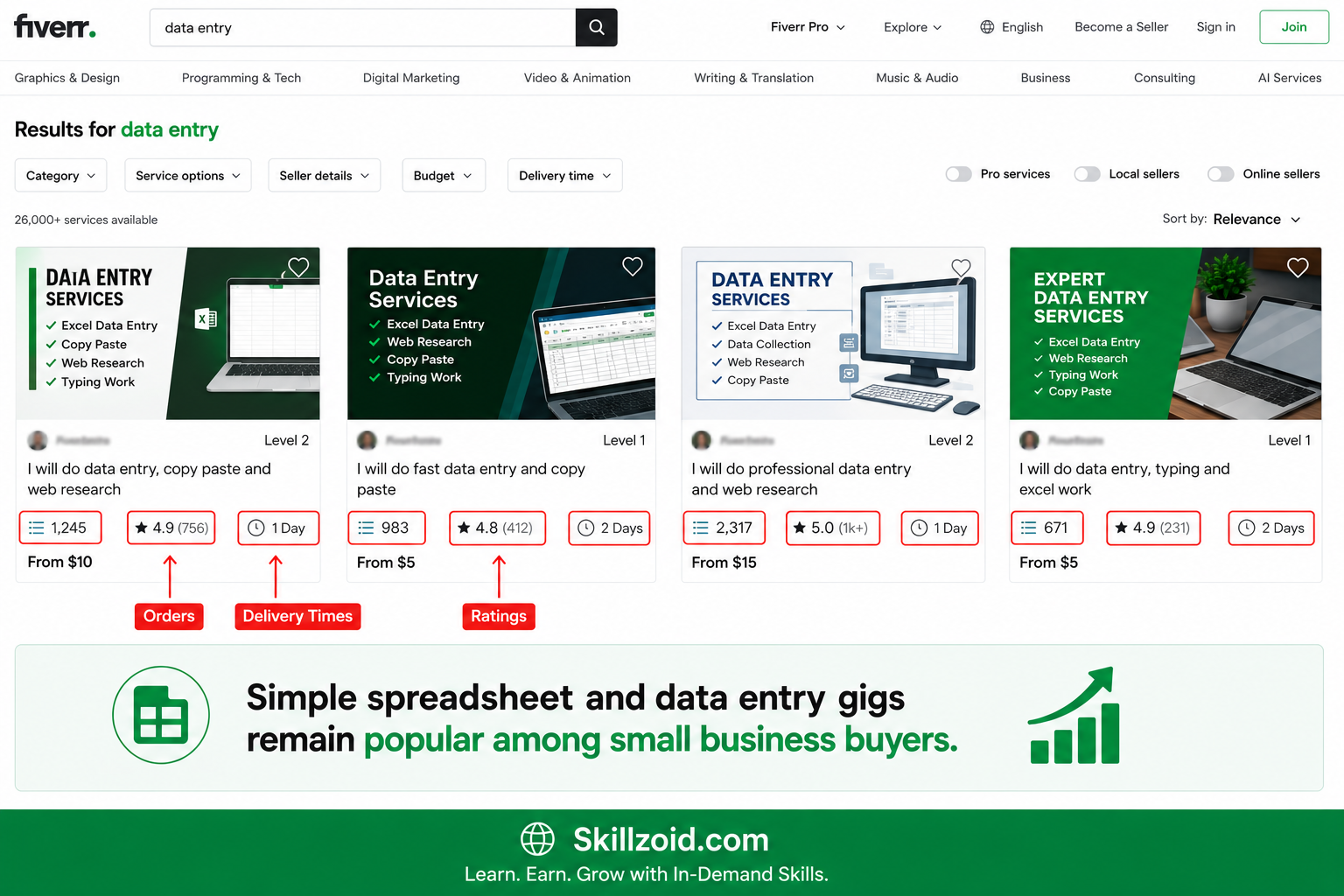
2. Copy-Paste and Web Research Tasks
This category overlaps with data entry, but deserves its own mention because the range of tasks here is wider than most beginners realize.
Buyers regularly need someone to:
- Search the internet for specific information and compile it into a document or spreadsheet
- Find contact details for businesses in a particular industry or location
- Collect product information from multiple websites and organize it in one place
- Research competitors and summarize findings in a readable format
If you’re comfortable using Google, know how to open multiple tabs, and can organize what you find clearly, this is a sellable service.
The key to making this work on Fiverr is being specific in what you offer. “I will research and compile a list of 50 businesses in your niche with contact details” is far more attractive to buyers than a generic “I will do research for you.” Specificity builds confidence, especially when you’re a new seller with no reviews yet.
3. Transcription: Converting audio or video to text
Transcription requires one skill: careful listening. If you can type at a reasonable speed and pay attention, you can transcribe.
The work involves listening to audio or video recordings and typing out what’s being said. This is needed constantly by podcasters, researchers, lawyers, journalists, course creators, and anyone who has meetings or interviews they need in written form.
You don’t need special software to start, just a good pair of headphones and a word processor. As you get more comfortable and want to work faster, a free tool like oTranscribe (a browser-based transcription tool) makes the process smoother.
Rates on Fiverr typically run per audio minute. Beginners usually charge around $0.50 to $1 per minute of audio. A 30-minute recording earns you $15 to $30, and a focused typist can transcribe that in about 90 minutes to two hours.
Not the highest hourly rate, but it’s clean, simple work that produces consistent reviews, which is exactly what you need early on.
4. PDF Conversion and Basic File Formatting
This one surprises people, but there’s a real market for it.
Buyers frequently need documents converted between formats: PDF to Word, Word to PDF, image to editable text, and Excel to PDF. Some need their existing documents reformatted, margins adjusted, fonts standardized, a table of contents added, and headers cleaned up.
These tasks take someone who knows what they’re doing maybe ten to fifteen minutes. But for a business owner who doesn’t know how to do them and doesn’t want to figure it out mid-project, it’s worth paying someone $5 to $15 to just handle it.
Tools you need: Microsoft Word (if you have it) or LibreOffice (free and handles most of the same tasks). For PDF to Word conversion specifically, Smallpdf and ILovePDF both have free tiers that handle basic conversions well.
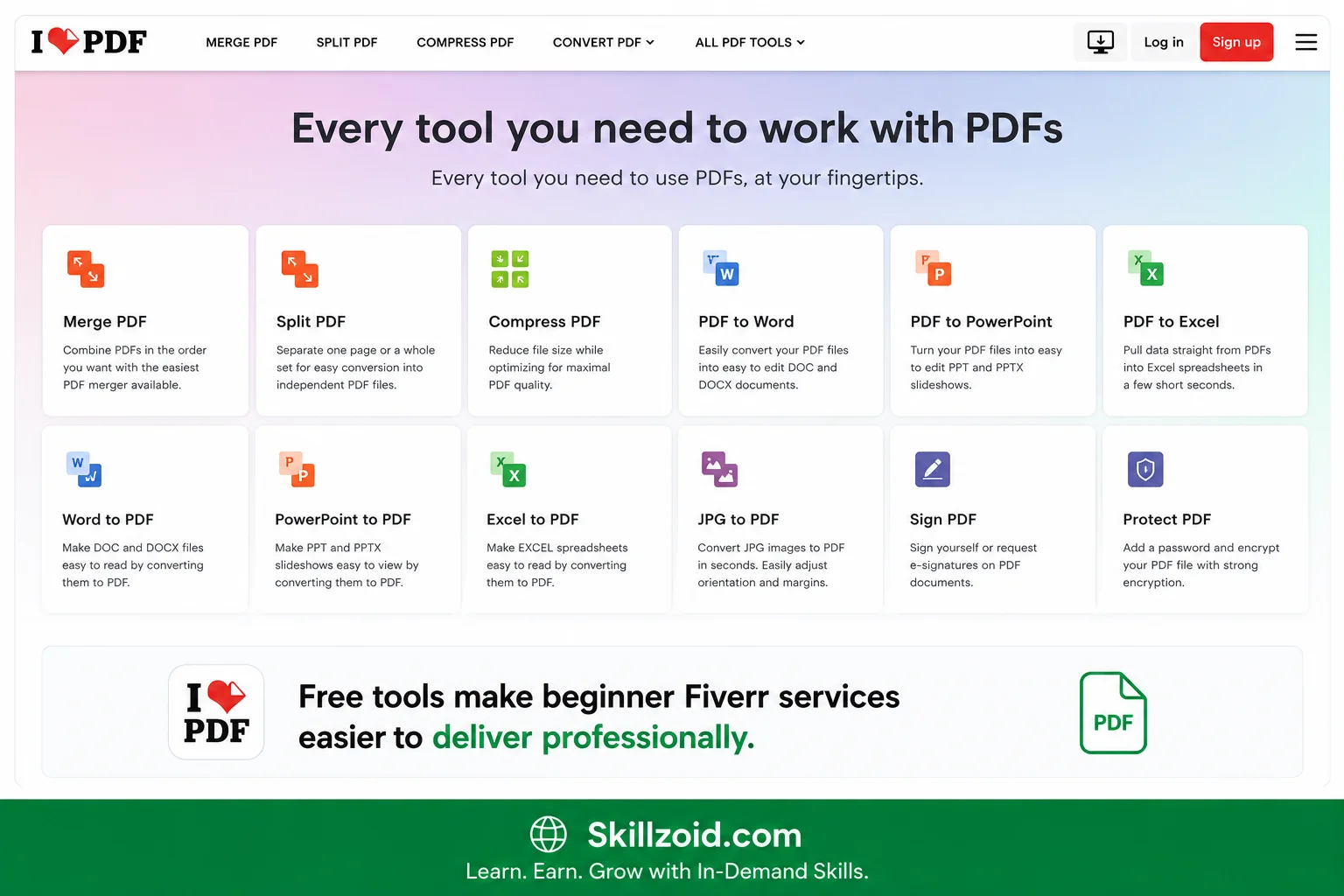
The gig setup is simple: list clearly what formats you convert, how fast you deliver, and how many pages are included in your base price. Buyers in this category are usually looking for fast, reliable, no-fuss delivery. That’s entirely achievable for a beginner.
5. Social Media Scheduling and Basic Management
This one sits at the slightly more involved end of the “no specialized skill” spectrum, but it’s still very accessible.
Many small business owners know they need to post consistently on Instagram, Facebook, or LinkedIn, but they don’t have the time to sit down and do it every day. They need someone to take their content (which they’ll provide) and schedule it using a tool like Buffer, Later, or Meta Business Suite.
If you can learn how to use one of these scheduling tools, which takes a few hours at most, you can offer this as a service. You’re not creating the content (that would require design or writing skills). You’re organizing and scheduling what the buyer already has.
Buffer and Later both have free plans that are enough to start with. Spend an afternoon learning how to connect social accounts, upload posts, write captions, and schedule them at specific times. That afternoon of learning is your entire preparation for offering this service.
Pricing typically starts at $15 to $30 per week of scheduling, depending on how many platforms and how many posts are involved.
6. Proofreading Simple Documents
If you have a strong grasp of English, not perfect, but genuinely good, proofreading is a service you can offer without formal training.
The buyers in this category are typically non-native English speakers who have written something (an email, a short article, a business proposal) and want someone to catch grammatical errors and awkward phrasing before they send it.
They’re not expecting a professional editor who restructures their writing. They want someone to read through carefully, fix obvious errors, and flag anything confusing. That’s a task most people with solid English can handle.
One honest note: Be realistic about your own English level before offering this. If you’re still learning the language yourself, this isn’t the right starting point. But if you’re comfortable reading and writing in English and regularly catch errors in others’ writing, it’s a legitimate starting service.
A free tool like Grammarly (the free version) can help you catch things your eye misses. Use it as a safety net, not a replacement for actually reading the document carefully.
How to set up your first gig when you have no reviews
This is the practical part that most beginners get stuck on, not what to offer, but how to launch when you have no track record yet.
Write a gig title that’s specific and searchable. Use Fiverr’s search autocomplete to find what buyers are actually typing. “I will do data entry from PDF or image to Excel spreadsheet” is better than “I will do data entry work.”
Set a competitive but not embarrassingly low price. Starting at $5 signals desperation and attracts difficult buyers. Starting at $10 to $15 for a clearly defined deliverable is more reasonable and still accessible enough for a buyer to take a chance on a new seller.
Write your gig description for the buyer, not yourself. Start with what problem you’re solving for them. Keep it clear, keep it short, and be very specific about what’s included in each package.
Get your first order through your network. Tell friends, family members, or classmates who have genuine tasks they need done. Ask them to place a real order through Fiverr, not for a fake review, but because you want to practice delivering and earn a legitimate first review. That first review changes everything.
Respond to every message within an hour if you can. This builds your response time metric, which is visible on your profile and influences how seriously buyers take you.
Mistakes my cousin made that you can skip
Offering five different gigs at once. He thought more gigs meant more chances. What actually happened was that none of them got enough individual traction. He eventually focused on data entry alone, and that’s when orders started coming.
Copying his gig description from a competitor. He thought he was being smart. Fiverr’s system flagged the similarity, and his gig visibility dropped. Always write your own description.
Delivering late on his second order. He underestimated how long the task would take and missed his delivery deadline by a few hours. The buyer was understanding, but the late delivery hurt his on-time delivery rate and took weeks to recover. Overestimate how long tasks will take until you know your own speed reliably.
Pricing too low and then resenting it. His first gig was priced at $5. The buyer placed an order for a 200-row spreadsheet and expected it to be done in 24 hours. He did it, but he felt taken advantage of, which affected his motivation. Price your work so that when an order comes in, you feel good about completing it.
What actually happens in the first 90 days
Let me give you a realistic picture because the internet has too many unrealistic ones.
In your first two to four weeks, you’ll probably get zero orders from organic search. Your gig is new, Fiverr doesn’t know if it converts yet, and you’re invisible to most buyers. Use this time to get your first one or two orders through personal contacts.
By weeks four to eight, with a couple of real reviews on your profile, you’ll start seeing organic inquiries. Not a flood, but real buyers finding your gig and reaching out.
By month three, if you’ve completed orders consistently, responded promptly, and maintained quality, you’ll have a small but functioning profile that generates occasional orders on its own.
From there, it grows, slowly but predictably.
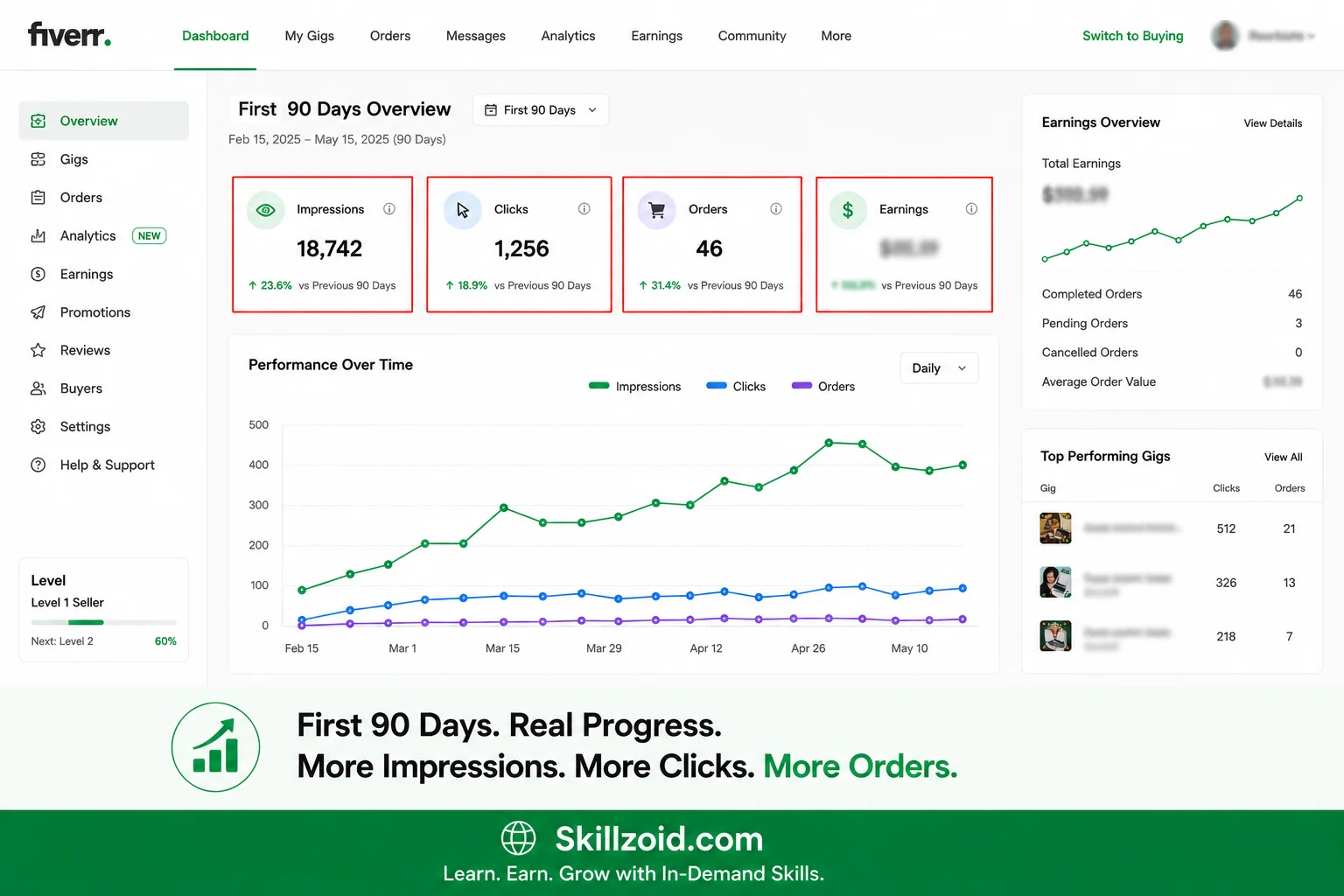
The people who give up do so in that first silent month, before any organic traction has had time to develop. The people who stick through it find that the platform rewards consistency in a very direct, measurable way.
One thing worth being honest about
“No skill” is a starting point, not an endpoint.
Every person who’s building a meaningful income on Fiverr eventually develops real expertise in something, even if they started with simple data entry. They get faster, they specialize, they raise their prices, and they add more sophisticated services over time.
My cousin has already started learning basic Excel formulas because buyers have been asking for slightly more complex spreadsheet work. He didn’t set out to learn Excel; the work pulled him toward it naturally.
That’s actually how most successful freelancers develop their skills: not by taking a course first and then starting, but by starting with what they have and growing into more as the work demands it.
So if you’re sitting there thinking you have nothing to offer, you’re probably wrong. Start with whatever’s on this list that fits what you can do today, and let the experience build from there.
Taha Sohail is a blogger and cyber engineer who writes about freelancing, online earning, and digital skills at Skillzoid.com.
Related reading: Best Fiverr Skills Beginners Can Learn in 30 Days | How to Build a Full-Time Income on Fiverr in 2026 | How to Rank a Gig on the First Page of Fiverr in 2026




3 Comments on “How to Earn Money on Fiverr Without Any Skill (Beginner’s Guide 2026)”