
Disclaimer: This post is for educational purposes only. It does not contain affiliate links. All information is based on personal experience and research. I have no financial relationship with any platform or service mentioned in this article.
The word “passive” gets thrown around so carelessly in the online income space that most people roll their eyes when they hear it.
I get that. I was skeptical, too.
But here’s what changed my mind: one morning I woke up, made tea, sat down at my laptop, and found three commission notifications in my email from Fiverr’s affiliate program. I had not done any active work the night before. The blog posts those commissions came from had been published weeks earlier.
That’s not a fantasy. That’s what affiliate marketing actually looks like once the content you created starts doing the work for you. The “passive” part isn’t that you do nothing, it’s that the work you did once keeps generating results long after you stopped actively working on it.
The Fiverr affiliate program is one of the more accessible ways to get to that point. It’s free to join, the commissions are meaningful, and Fiverr has enough brand recognition that you’re not trying to convince people to trust an unknown platform.
This guide covers everything: how the program actually works, how to build content that drives conversions, and the specific mistakes that will slow you down if you make them.
What the Fiverr affiliate program actually offers
Let’s get the mechanics out of the way clearly, because the commission structure matters for how you plan your strategy.
Fiverr’s affiliate program pays on a CPA model, Cost Per Acquisition. You earn a flat commission when someone who has never purchased on Fiverr before clicks your affiliate link and completes their first order.
The commission amount varies by category:
- Most standard service categories pay around $15 to $50 per first-time buyer
- Higher-value categories like Tech & Programming or Business can pay up to $150
- Fiverr Business referrals have their own separate structure
The 30-day cookie window means that if someone clicks your link today and doesn’t buy until three weeks later, you still earn the commission. That window gives your content time to work even when buyers are still deciding.
Here’s the key thing to internalize: you earn based on the category the buyer purchases from, not the price of the gig they choose. A buyer who clicks your link and spends $15 on a logo earns you the same commission as one who spends $80 on a logo, because both orders fall in the same category tier.
This completely changes how you think about promotion. You’re not chasing expensive gigs. You’re chasing categories with strong conversion potential and high buyer intent.
Step 1: Sign up and understand your dashboard
Signing up for Fiverr’s affiliate program is straightforward. Go to affiliates.fiverr.com, fill out the application, and you’ll typically get approved within a few days. There’s no minimum traffic requirement to apply, which makes it accessible even if you’re just starting.
Once you’re in, your dashboard shows:
- Total clicks on your links
- Conversions (first-time buyers who completed an order)
- Earnings and pending payouts
- Traffic sources (which content is driving clicks)
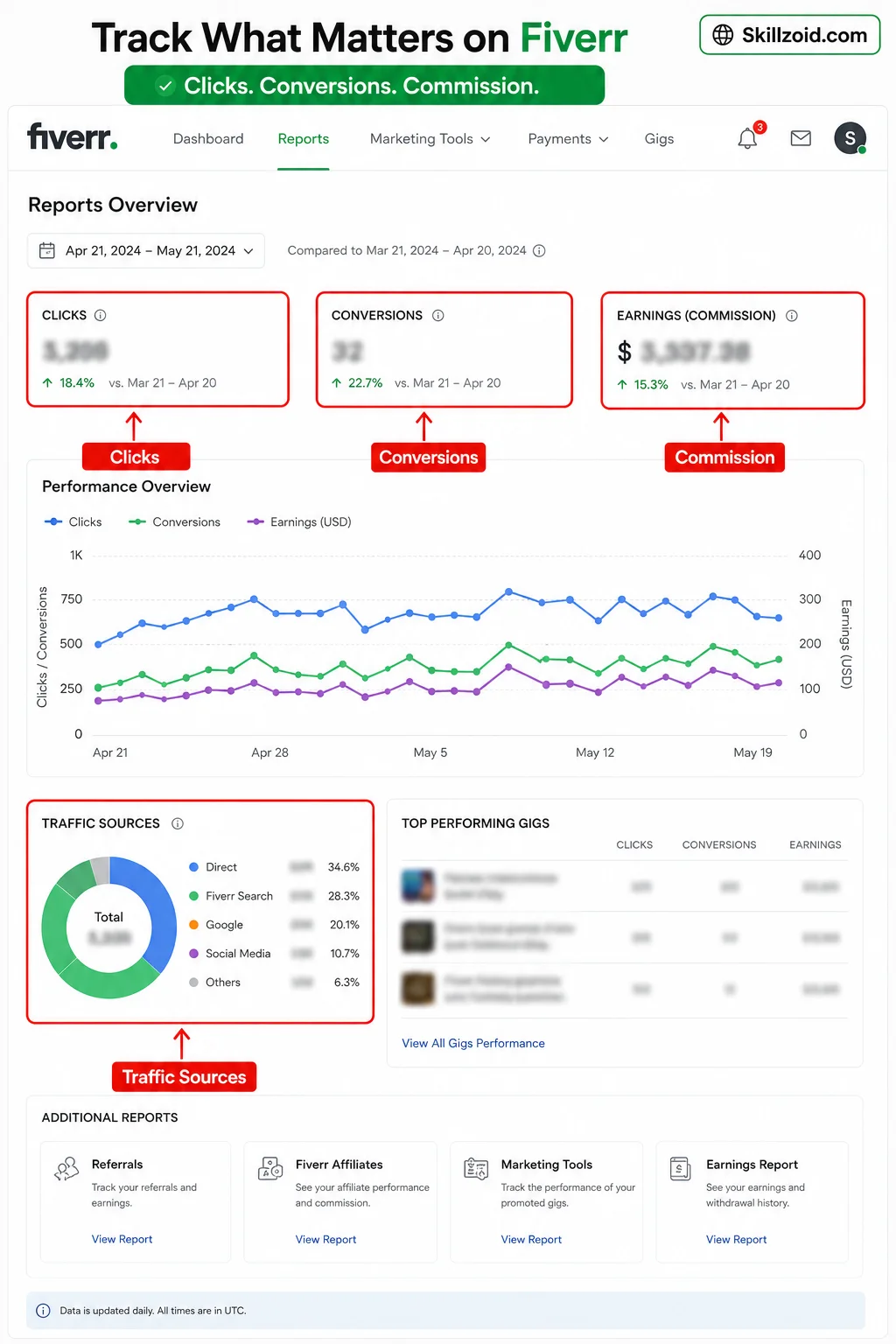
Pay attention to the traffic sources section. This becomes important as you grow; it tells you which articles, videos, or platforms are actually sending converting traffic, so you know where to invest more effort.
Your affiliate links can be generated for specific Fiverr pages: the homepage, category pages, subcategory pages, or individual gig pages. As I’ll explain later, category pages tend to convert better than linking to a single gig.
Step 2: Choose your content platform strategically
Here’s something I wish someone had told me clearly at the beginning: the Fiverr affiliate program rewards content that reaches people at the right moment, when they’re actively looking for a solution that Fiverr can provide.
The platform you choose should be the one where you can consistently create that content and where your target audience already spends time.
A blog or website is the most sustainable long-term platform. A well-written post that ranks in Google can drive clicks for months or years without any additional effort on your part. This is where the “passive” element becomes most real. The trade-off is that it takes time, both to write the content and to wait for it to rank.
YouTube is underutilized for Fiverr affiliate promotion. Most people think of YouTube as entertainment-first, but a significant number of YouTube searches are genuinely informational, with people looking for tutorials, comparisons, and how-to guides. A video titled “I hired a Fiverr logo designer, here’s exactly what happened” attracts viewers who are already thinking about Fiverr. Your affiliate link in the description captures those clicks.
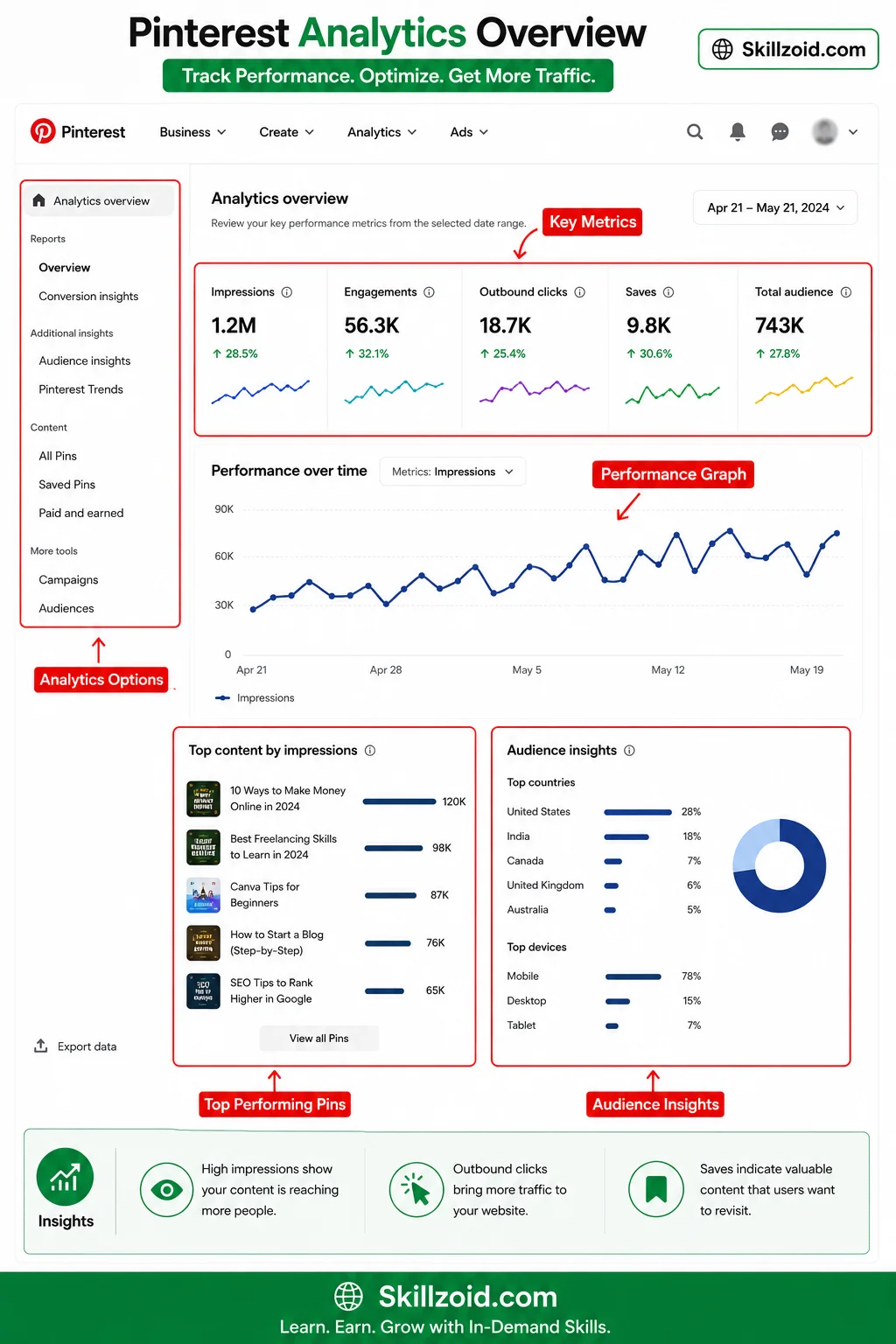
Pinterest operates more like a search engine than a social platform. Pins have a much longer lifespan than social media posts; a well-designed pin can drive traffic for a year or more. If your content is blog-based, use Pinterest to drive traffic to your posts rather than linking directly to Fiverr. This builds your site’s traffic while also generating affiliate conversions.
Email newsletters work well if you already have a list. A casual mention of Fiverr within a helpful newsletter, “I hired someone on Fiverr to handle this, here’s how it went,” drives clicks from readers who already trust your judgment.
Pick one or two platforms to start. Trying to be everywhere at once spreads your effort too thin and produces mediocre results on every channel instead of meaningful results on one.
Step 3: Create content that reaches buyers at the right moment
This is the part that determines whether your affiliate efforts actually convert or just generate clicks that go nowhere.
The key insight: people who are about to buy on Fiverr don’t search “Fiverr affiliate.” They search for the problem they’re trying to solve. Your content needs to meet them at that problem.
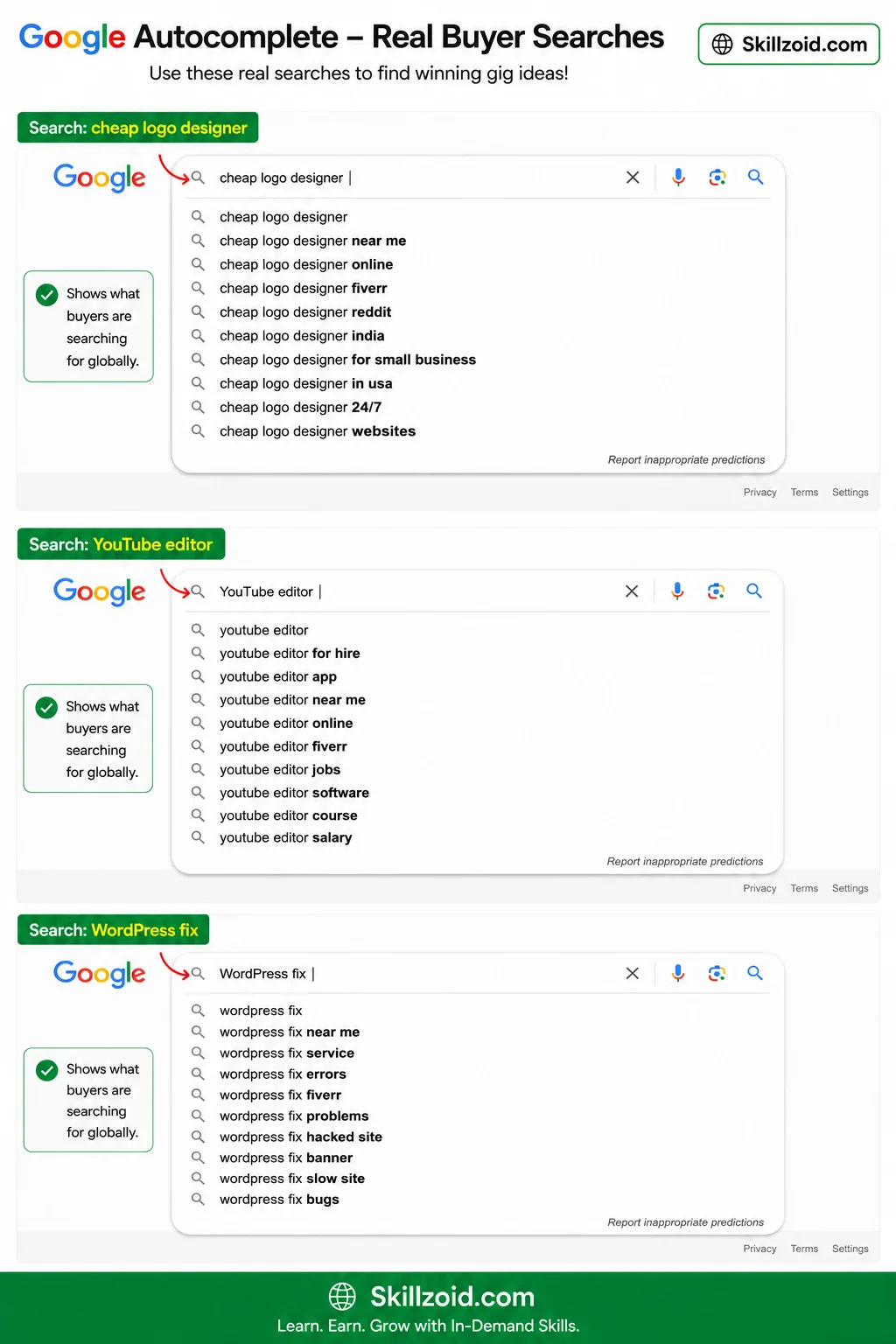
Think about what someone types into Google right before they’d need a Fiverr service:
- “How to get a logo made without hiring a designer.”
- “Where to find an affordable video editor for my YouTube channel?”
- “How to fix my WordPress website without coding.”
- “Best way to get voiceover for my explainer video.”
These people are one step away from landing on Fiverr and placing an order. If your content appears when they’re searching, explains their options clearly, mentions Fiverr as a practical solution, and links to the right category page, the conversion follows naturally.
The content that doesn’t convert is the generic “Top 10 Fiverr Gigs” list with affiliate links plastered everywhere. Buyers see through it immediately. It reads like an ad, not like help.
The content that does convert is specific, experience-based, and genuinely useful. A post about “I needed a podcast intro designed and had no budget, here’s exactly what I found on Fiverr, what it cost, and whether I’d use it again” is infinitely more compelling than a keyword-stuffed list.
Write the second kind.
Step 4: Link to category pages, not individual gigs
This is a tactical detail that made a noticeable difference in my conversion rate once I switched.
When you link to a single seller’s gig, you’re betting that the buyer will connect with that specific seller. If they don’t, if the seller’s style doesn’t fit, the price feels off, the delivery time is too long, the buyer leaves. You lose the conversion.
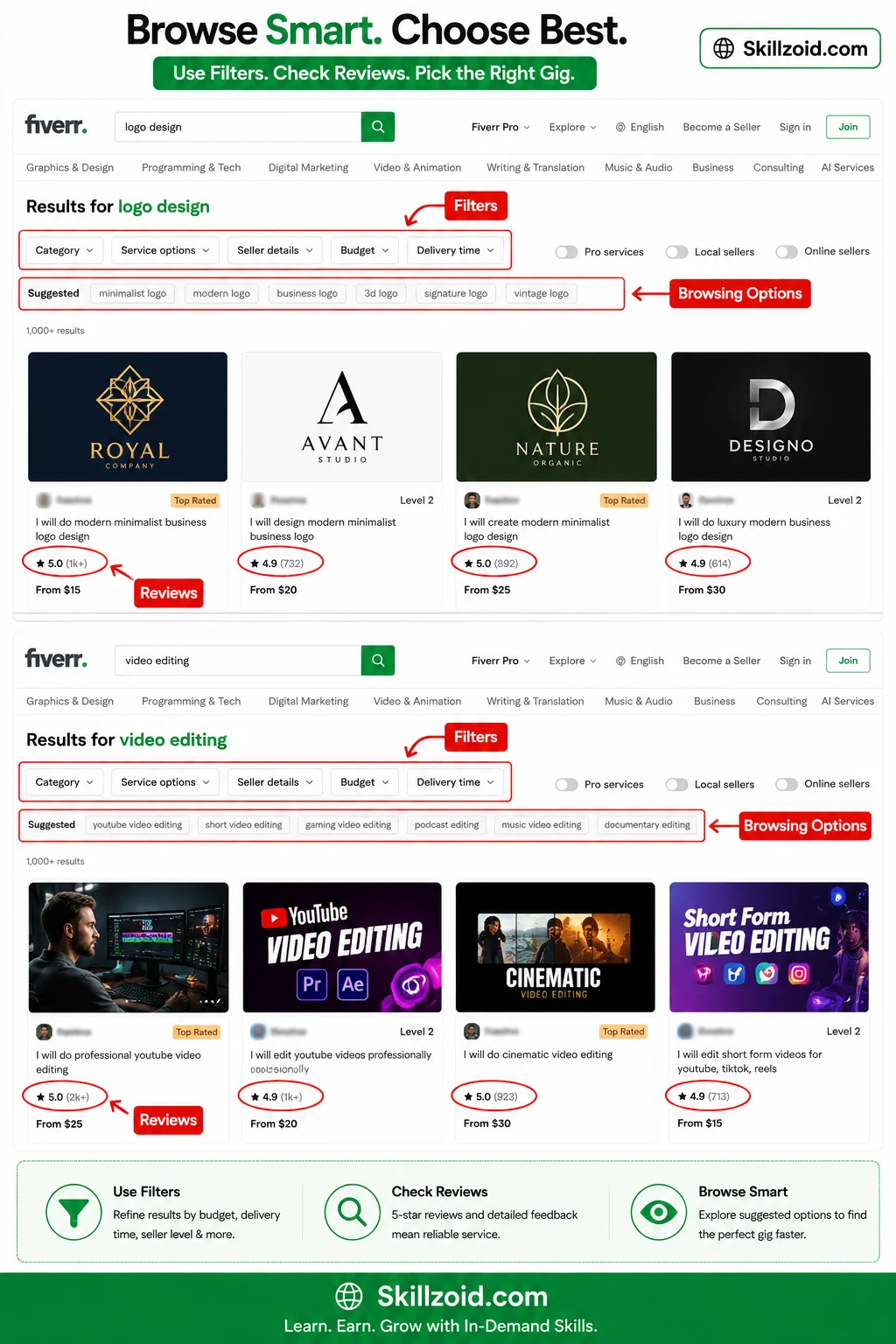
When you link to a category or search results page, the buyer lands in an environment where they can browse, compare, and find something that fits their specific need. Buyers who browse convert at a higher rate than buyers who feel pushed toward one specific option.
For example, instead of linking to a specific logo design gig, link to Fiverr’s logo design category page with your affiliate tracking code. The buyer has a choice. Choice leads to orders. Orders lead to your commission.
The exception: if you’re writing a review or case study about a specific seller you’ve genuinely worked with, linking to their gig makes sense because the context justifies the specificity.
Step 5: Build a content library, not just a single post
One of the most common mistakes people make with affiliate marketing is publishing one piece of content, checking the results after two weeks, and giving up when nothing dramatic happens.
Affiliate income from content compounds. Each additional piece of content you publish is another entry point, another search term you can rank for, another way a potential buyer can find their way to your affiliate link.
Ten solid, well-targeted articles bring in more consistent income than one viral post, because the ten articles capture different search intents, different buyer stages, and different Fiverr service categories.
My approach when building affiliate content for Fiverr: I grouped articles into clusters. One central piece about Fiverr in general, then supporting articles about specific services (logo design, video editing, WordPress help), then more specific pieces about how to use each service effectively. These articles link to each other, which helps them rank in Google while also keeping readers engaged longer.
Aim to publish consistently rather than perfectly. A good article published regularly beats a perfect article published once every two months.
The mistakes that cost me time and money early on
Promoting too broadly. My early content tried to appeal to everyone who might ever use Fiverr. It appealed to nobody specifically. The narrower your content’s focus, the better it converts. “Small business owners who need a logo” is a better audience to write for than “anyone who might need a freelancer.”
Checking my dashboard obsessively. In the first month, I was checking my affiliate dashboard every day, sometimes multiple times a day. It created anxiety and gave me no useful information because affiliate results take weeks to develop. I eventually set a rule: check the dashboard once a week, every Friday. That made the process much less stressful.
Writing for search engines instead of people. Some of my early articles were technically keyword-optimized but felt robotic to read. They ranked reasonably well but converted poorly because buyers could sense they weren’t written for them. The shift to writing for a real person first, and letting SEO considerations come second, improved both my rankings and my conversions.
Not disclosing the affiliate relationship. The FTC in the US and equivalent regulatory bodies in other countries require that you disclose when you have a financial relationship with a brand you’re recommending. Beyond the legal requirement, disclosure actually builds trust. Readers who know you earn a commission and choose to click anyway are more committed buyers than readers who feel tricked. Always disclose.
Giving up after a slow month. Month two of my Fiverr affiliate efforts was significantly slower than month one. I nearly quit. What I didn’t realize was that several of my articles were still working their way up the search rankings, and the commissions from that “slow” month’s content started arriving in months three and four. Affiliate marketing has a lag built into it. Patience isn’t optional; it’s part of the strategy.
A realistic picture of what you can earn
I want to be straightforward here because there’s an enormous amount of exaggerated income content in this space.
In the first one to two months, if you’re starting from scratch with no existing audience, you’ll likely earn very little. A few clicks, possibly a conversion or two. That’s normal.
By months three to six, with a library of targeted content and some search engine traction, consistent monthly commissions become realistic. What “consistent” means depends heavily on your niche, your writing quality, and how much you publish, but $100 to $400 a month is achievable for someone who’s genuinely putting in the effort.
Beyond the six-month mark, assuming you’ve kept publishing and your content is ranking, income tends to grow more predictably. Some sellers with established content libraries earn $1,000 or more monthly from the Fiverr affiliate alone. That’s not guaranteed, it requires real work and a real strategy, but it’s not fiction either.
The passive element becomes more real over time, not immediately. The first months are entirely active, creating content, learning what converts, and improving your approach. Eventually, the library you’ve built starts generating income that isn’t proportional to the hours you’re currently working. That’s the actual payoff, and it’s worth working toward honestly.
Where to go from here
If you’re ready to start, the sequence is simple:
Sign up at affiliates.fiverr.com. Pick one platform, blog, YouTube, or Pinterest, where you can create content consistently. Write your first piece about a specific Fiverr service category, aimed at a specific type of buyer who needs that service. Add your affiliate link to the relevant category page. Publish it. Then write another one.
The compounding effect of content-based affiliate marketing doesn’t show up in week one. But it shows up, and when it does, waking up to commission notifications you didn’t have to actively work for that morning starts to feel genuinely satisfying.
Taha Sohail is a blogger and cyber engineer who writes about freelancing, cybersecurity, online income, and digital skills at Skillzoid.com.
Related reading: Best Fiverr Services to Promote as an Affiliate in 2026 | How to Promote Fiverr Affiliate Links and Make Money in 2026 | How to Build a Full-Time Income on Fiverr in 2026




4 Comments on “How to earn passive income as a Fiverr affiliate in 2026 (Complete Guide)”