
I rewrote my gig description four times before I understood why it was not working.
The first version was too long, a wall of text that explained everything I could do in exhaustive detail. The second was too short, three sentences that said nothing specific. The third tried to sound corporate and impressive. The fourth tried to copy a top seller’s description almost word for word, which felt dishonest and read as awkward because it was not my voice.
None of them converted well.
The fifth version finally worked. And the strange thing is, it was the shortest, most direct, and most plainly written of all of them. It did not try to impress anyone. It just answered the question every buyer silently asks when they land on a gig: “Is this the right person for what I need?”
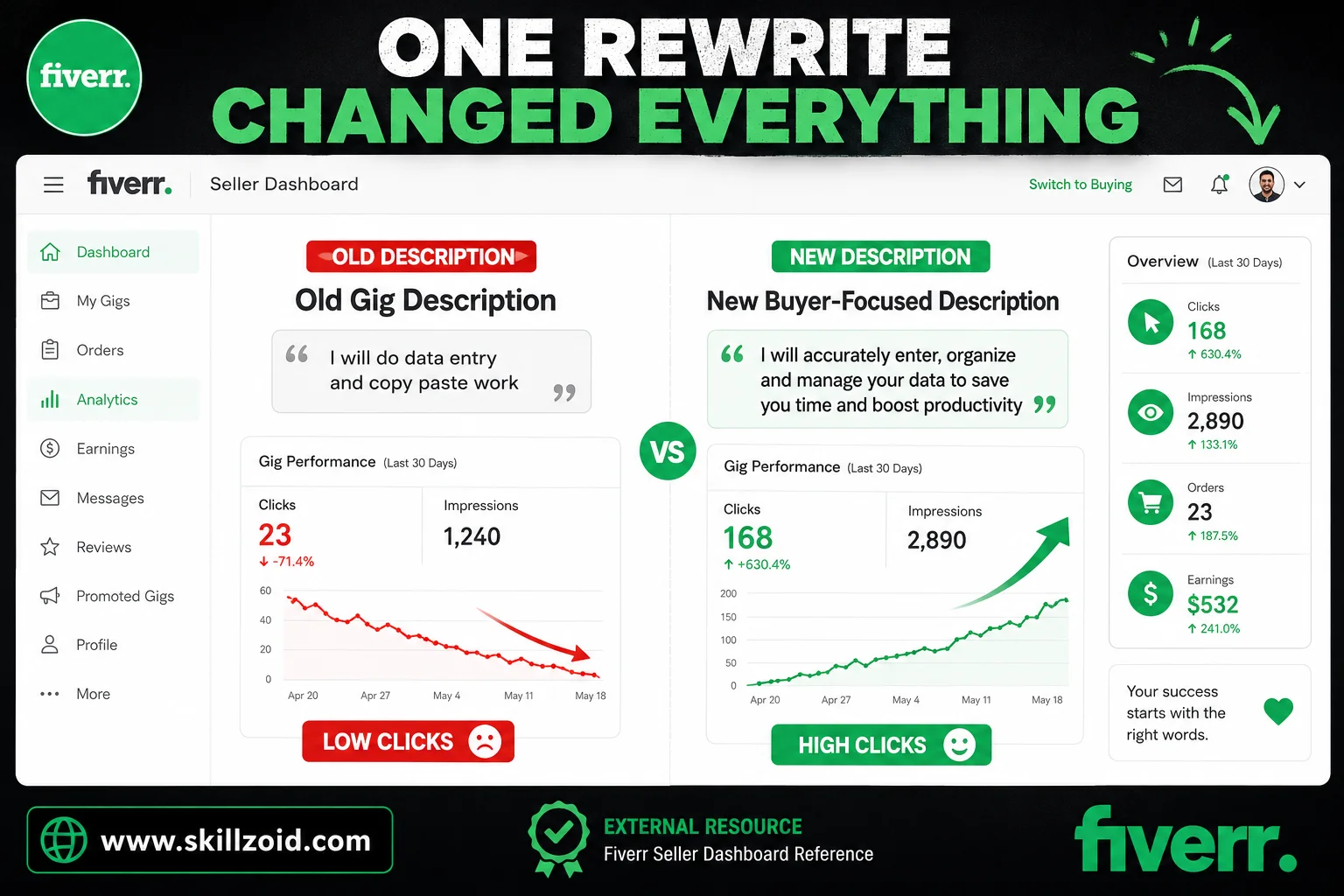
Writing a gig description that converts is not about sounding professional. It is about being clear, specific, and credible in the shortest possible space. Everything in this article is built around that principle, with real examples you can adapt immediately.
What a Gig Description Actually Needs to Do
Before looking at examples, understand the job the description is performing.
By the time a buyer reads your description, they have already seen your thumbnail and glanced at your title. Those two things got them to click. The description’s job is to close, to answer the remaining questions clearly enough that the buyer either orders or sends a message.
Those remaining questions are almost always the same:
- What exactly do I get when I order this?
- Will this person understand what I need?
- Can I trust them to deliver something good?
- Is this the right gig for my specific situation?
A gig description that answers all four of those questions clearly will convert buyers. A description that answers none of them, or buries the answers in generic filler, will lose them.
Keep that framework in mind as you read the examples below. Every good description is doing exactly this work, even when it does not look like it on the surface.
The Structure That Works Consistently
After testing multiple description formats across different gig types, one structure works better than the others for most service categories:
Opening line: One sentence that names the specific result the buyer gets. Second paragraph: Brief explanation of your process or approach, what makes your work different or reliable. Third paragraph: What is included in the order, specific, concrete deliverables? Short list: Three to five bullet points listing key features or inclusions. Closing line: A low-pressure invitation to message you before ordering.
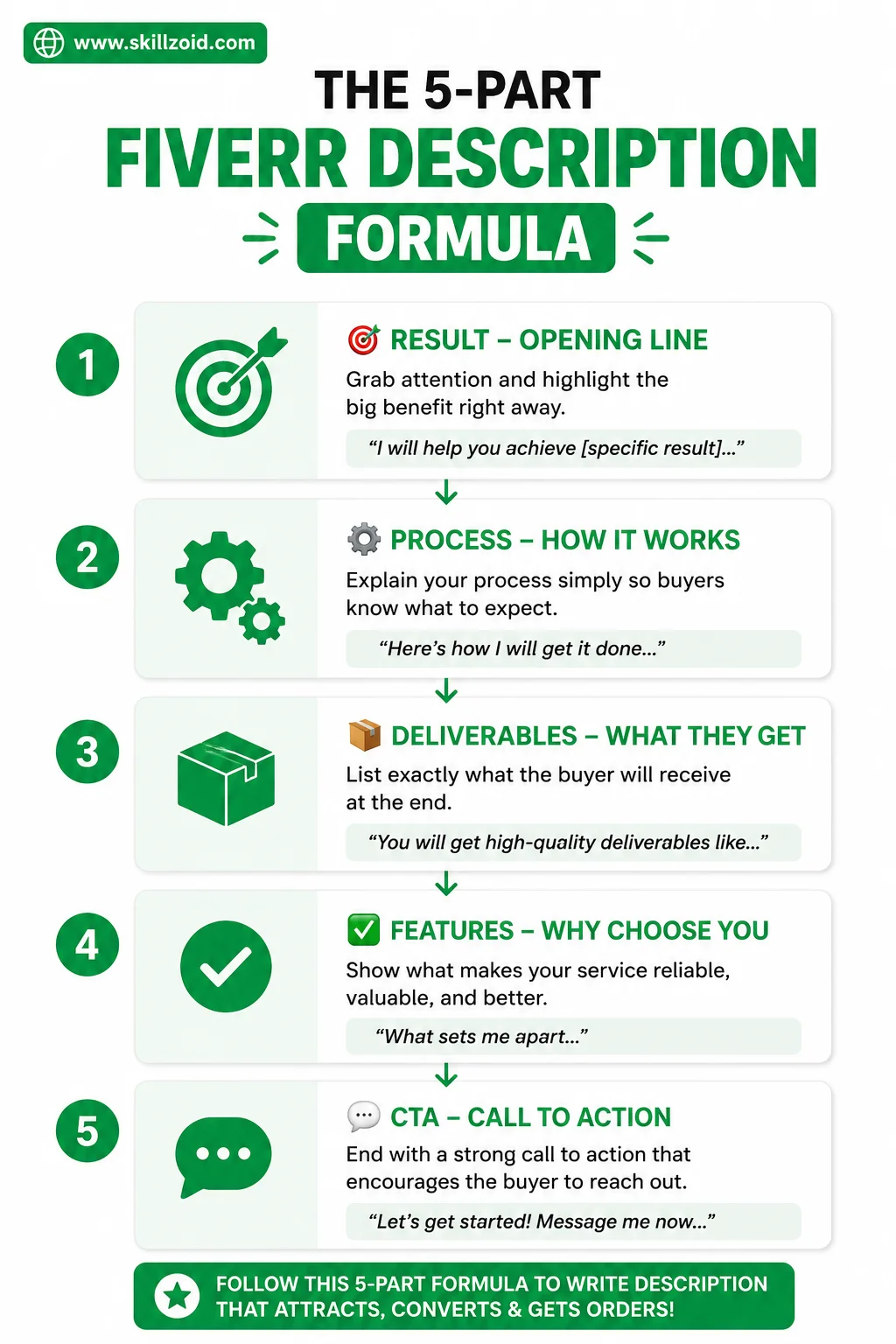
This is not a rigid template; it is a shape. The content inside it changes completely depending on your service. But the shape itself works because it mirrors the way buyers actually read gig descriptions: result first, then process, then specifics, then decision.
Real Gig Description Examples by Category
The examples below are written in the voice and style I use for my own gigs and for sellers I have helped optimise their profiles. They are not copied from existing gigs; they are constructed to demonstrate the principles above. Use them as a starting point and rewrite them in your own voice, with your own specific experience.
Example 1: SEO Blog Post Writing
You will receive a well-researched, SEO-optimised blog post that is written for real readers, not just search engines.
I write blog content for tech, cybersecurity, and digital marketing brands. My articles are structured around a target keyword, include proper heading hierarchy, and are written in a tone that matches your brand voice, not the generic “informative” style that fills most blogs with forgettable content.
Every article I deliver includes:
- Original research from credible sources (no Wikipedia, no recycled opinion).
- Proper H1, H2, H3 heading structure for SEO.
- A meta description written to your specification.
- One round of revisions if needed.
- Delivery in Google Docs or Word format.
Word count, topic, and target keyword can all be discussed before you order. Just send me a message, and I will let you know if your project is a good fit.
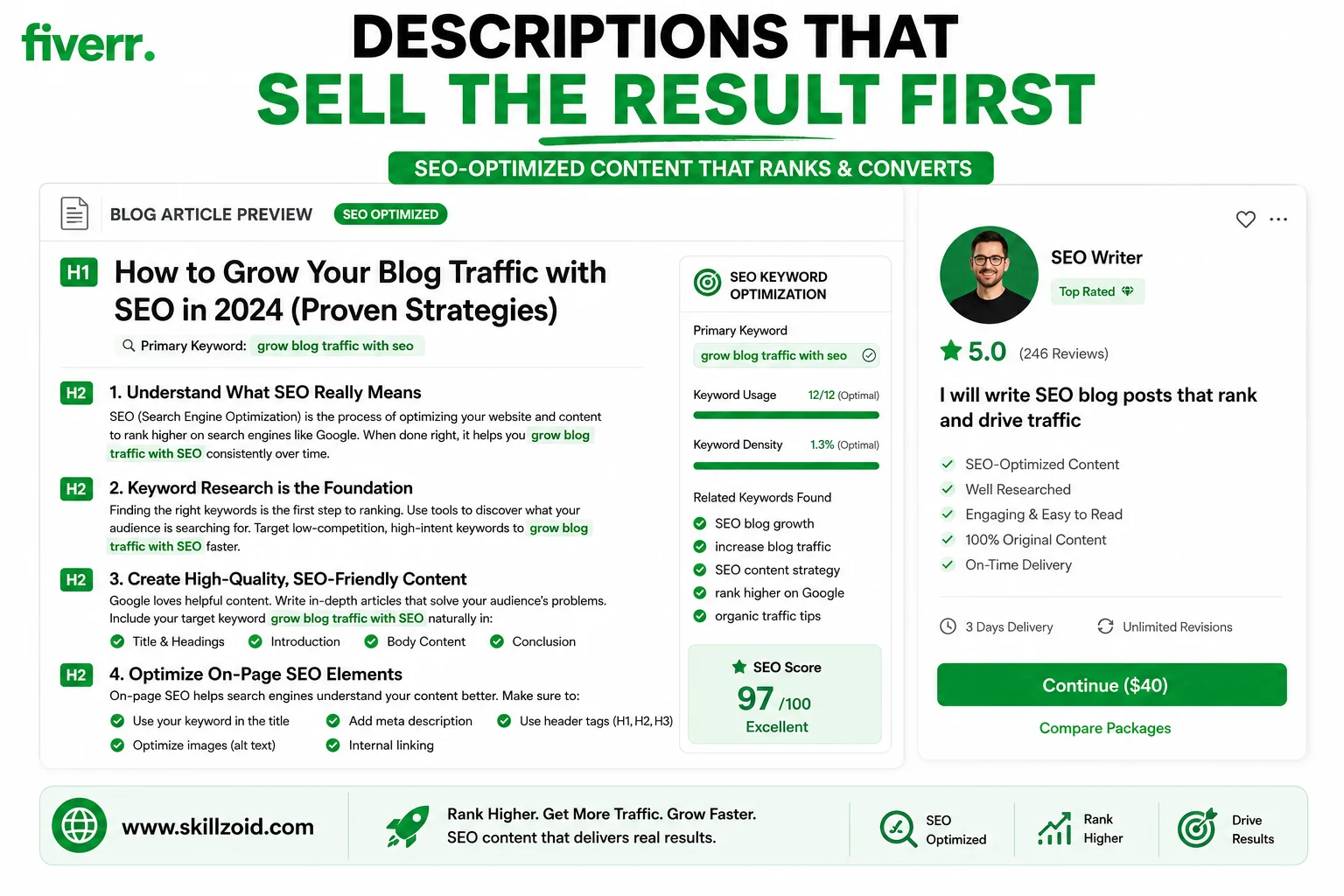
Why this works: It opens with the result (“well-researched, SEO-optimised blog post”), differentiates in the second paragraph (“real readers, not just search engines”), lists specifics concisely, and closes with a no-pressure invitation to message. It does not use the words “professional,” “passionate,” or “dedicated”, the three most overused and meaningless words in Fiverr descriptions.
Example 2: Logo Design
You will get a clean, distinctive logo that reflects your brand identity, not a clip-art combination with your name dropped in.
I design logos that work across all formats: website header, business card, social media profile, and printed materials. Before I start, I ask you about your industry, your target audience, and the brands you admire, because a logo that looks great but does not fit your market is not good.
Your order includes:
- Two initial logo concepts.
- Source files in AI, EPS, SVG, and PNG formats.
- Both colour and black-and-white versions.
- Commercial use rights.
- no restrictions.
- Two rounds of revisions.
If you have a brief, a mood board, or reference logos you like, share them when you message me. The more context I have upfront, the stronger the first concepts will be.
Why this works: The opening immediately separates this from low-quality gigs (“not a clip-art combination”) without being arrogant. The second paragraph explains the design process in a way that signals professionalism. The list is specific, with no vague inclusions like “high quality files.” And the closing tells buyers exactly what to share upfront, which reduces back-and-forth and sets the order up for success.
Example 3: Video Editing for YouTube
You will get a polished, audience-ready YouTube video, properly colour graded, audio cleaned, transitions smooth, and captions added if needed.
I edit long-form YouTube content, shorts, product reviews, and talking-head videos. I work in Premiere Pro and DaVinci Resolve. Turnaround time depends on video length; send me the raw footage duration, and I will give you an accurate timeline before you order.
Standard delivery includes:
- Full edit with cuts, transitions, and pacing adjustments.
- Colour correction and basic audio cleanup.
- Intro and outro integration, if you have one.
- Export in 1080p MP4, optimised for YouTube upload.
- One revision round included.
If you have a specific editing style you want, fast cuts, cinematic pacing, documentary feel, mention it in your message. I will match it.
Why this works: “Audience-ready” in the opening is a buyer-focused result. The mention of specific software (Premiere Pro, DaVinci Resolve) builds credibility without being showy. Asking for the raw footage duration before ordering is a genuinely practical move that experienced editors know matters; it signals real experience to buyers who have worked with editors before.
Example 4: English to Urdu Translation
You will receive an accurate, natural-sounding Urdu translation, not a Google Translate output that a native speaker would immediately notice.
I am a native Urdu speaker with a background in English-language media and professional writing. I translate business documents, website content, marketing copy, and articles. I maintain the tone and intent of the original, formal documents stay formal, conversational content stays natural.
Every translation includes:
- Native-speaker accuracy with proper grammar and script formatting.
- Preserved formatting where possible (headings, bullet points, paragraph breaks).
- Delivery in the same file format you provide (Word, PDF, Google Docs).
- One revision if any section needs adjustment.
For longer documents, share a word count or page count in your message so I can give you an accurate price and timeline.
Why this works: The opening lands a real pain point; buyers for translation services have often been burned by automated or low-quality translations. Mentioning “not a Google Translate output” immediately addresses the fear without being dismissive. The credentials are specific and credible. And the closing handles the practical question of pricing for variable-length documents elegantly.
Example 5: Social Media Caption Writing
You will get captions that sound like a real person wrote them, because a real person did.
I write Instagram, LinkedIn, Facebook, and TikTok captions for brands, creators, and small businesses. My captions are written to match your brand voice, not a generic “inspirational quote + three hashtags” formula. I read your existing content before writing anything, so the new captions feel like a natural extension of what you have already been posting.
A standard order includes:
- Captions written to your specified platform and audience.
- Relevant hashtag sets researched for your niche.
- Two caption variations per post, so you can choose the one that fits.
- Delivery in a simple Google Docs format, ready to copy and post.
Share two or three of your existing posts in your message so I can understand your tone before I start writing.
Why this works: The opening is self-aware and slightly funny (“because a real person did”), it acknowledges the buyer’s fear (AI-generated captions) directly and disarms it with a light touch. “I read your existing content before writing anything” is a credibility signal that most caption writers do not include; it tells buyers this is not a one-size-fits-all service.
What Every Example Has in Common
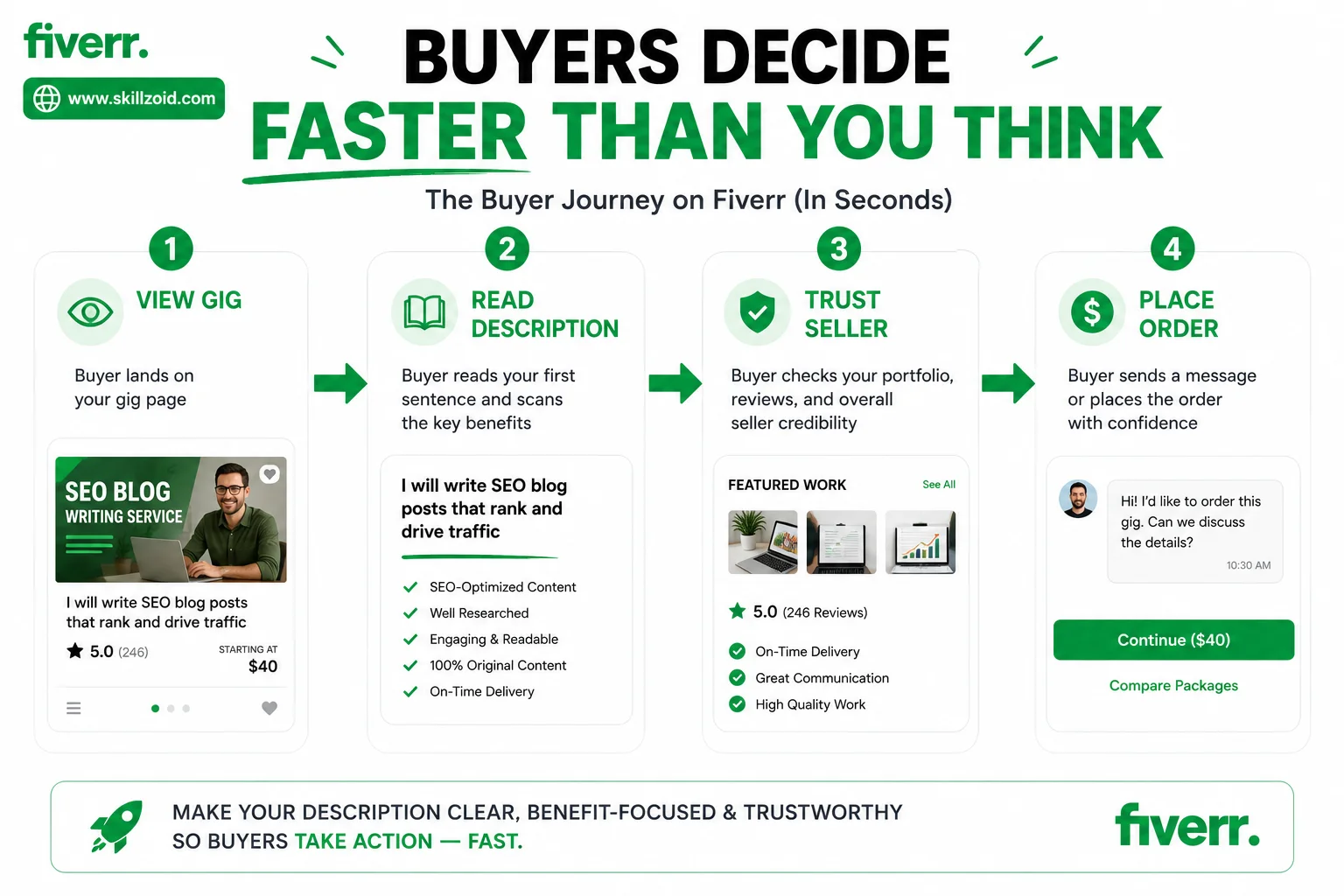
Look back at those five descriptions, and you will notice they all share the same characteristics:
They open with the buyer’s result, not the seller’s credentials. Not “I am a professional writer with five years of experience”, but “You will receive a well-researched, SEO-optimised blog post.” The buyer cares about what they get, not what the seller has done elsewhere.
They are specific about what is included. No vague promises. No “high-quality work delivered on time.” Actual deliverables, file formats, revision rounds, and specific inclusions.
They address a real buyer fear in the opening. Generic content, clip-art logos, Google Translate output, and AI-generated captions, each opening confronts the thing buyers in that category are most afraid of getting. Addressing fear directly is more persuasive than promising quality.
They invite a message before ordering. This reduces friction, improves order fit, and leads to better outcomes for both sides. Buyers who ask questions before ordering almost always have clearer expectations, which means fewer revision requests and higher review scores.
They do not use the word “professional” once. Professional is the most overused and least meaningful word in Fiverr descriptions. Everyone claims it. It signals nothing. Replace it with specifics that demonstrate professionalism instead of claiming it.
The One Rewrite That Changes Everything
If you only take one thing from this article, take this.
Find the first sentence of your current gig description. Read it honestly.
Does it start with “I am a professional…” or “I have X years of experience…” or “Welcome to my gig…”?
If yes, rewrite it. Right now, today.
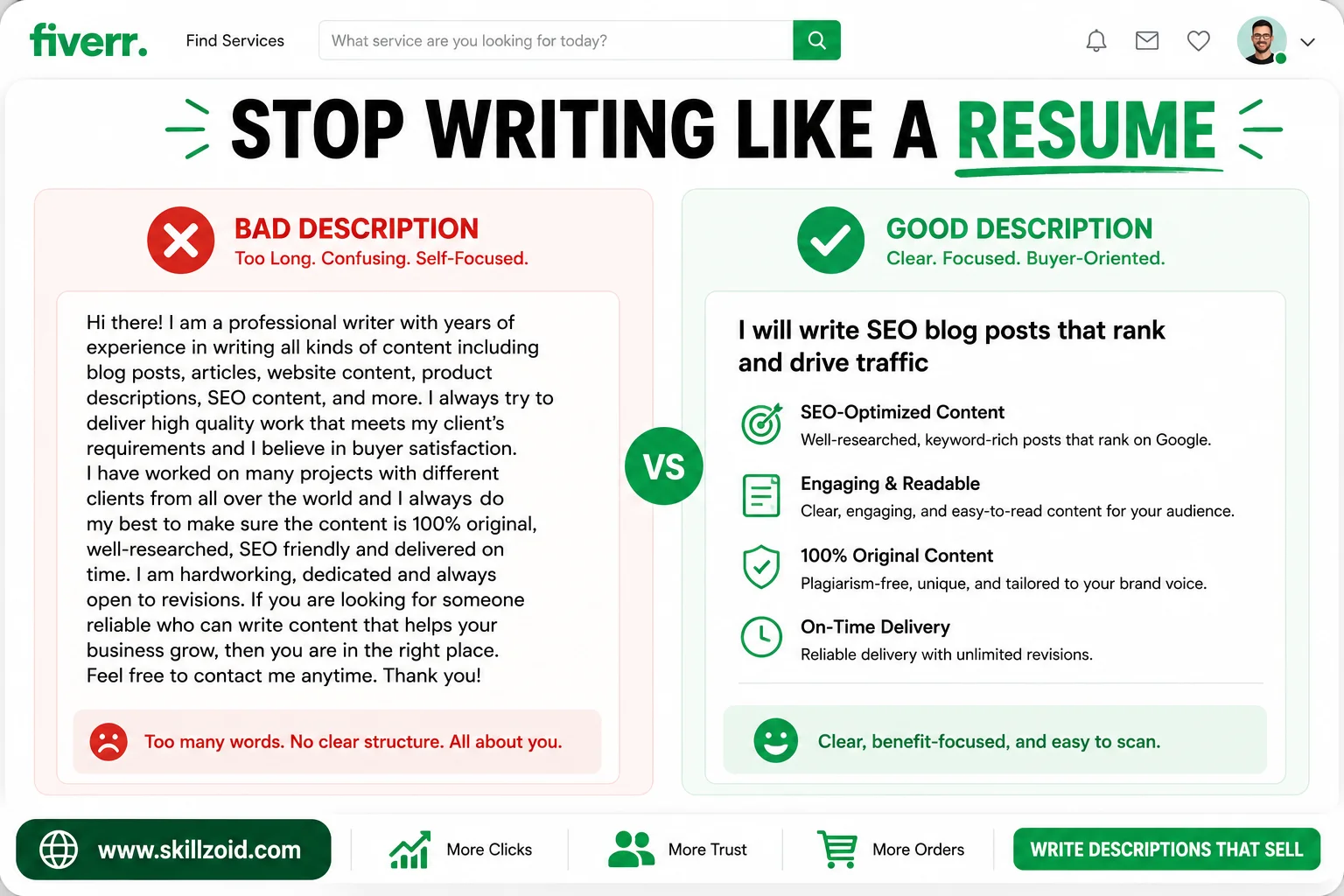
Replace it with a sentence that names the specific result the buyer receives. One sentence. Buyer-focused. Specific. No adjectives that any seller could claim.
That single change, just the first sentence, will improve your gig’s conversion rate more than any other edit you can make. Because the first sentence sets the frame for everything that follows. Get it right, and buyers read the rest of your description looking for reasons to order. Get it wrong, and they are already half-gone before they reach paragraph two.
Your description is not your resume. It is your answer to the only question that matters to a buyer landing on your page: “Is this what I am looking for?”
Make sure the answer is immediately, unmistakably yes.
If you want to get hired fast on Fiverr, read this guide: Ultimate Fiverr Portfolio Guide: Get Hired Faster in 2026.
Taha Sohail is a professional blogger and cyber engineer with hands-on Fiverr experience across content writing, technical articles, and profile optimisation. He writes practical, no-fluff guides for freelancers who want results rather than theory.